💡 Tip: The following article data is for reference only. Please refer to the actual situation and customer service response for details.
NerdQaxe++ Miner hashrate is not a single number; it depends on the firmware version you are running and the overclocking settings. For example, the latest Remastered edition offers a stable hashrate of approximately 5.2 Th+/s ±10% in default mode. With the community-developed "Beast Mode" firmware and specific voltage fine-tuning, some users report that with fan-cooling assistance, it can easily be overclocked to hit 6 TH/s. In simple terms, its hashrate is a hidden map waiting for you to unlock with your own hands.
Learn about NerdQaxe++ Remastered 🎯
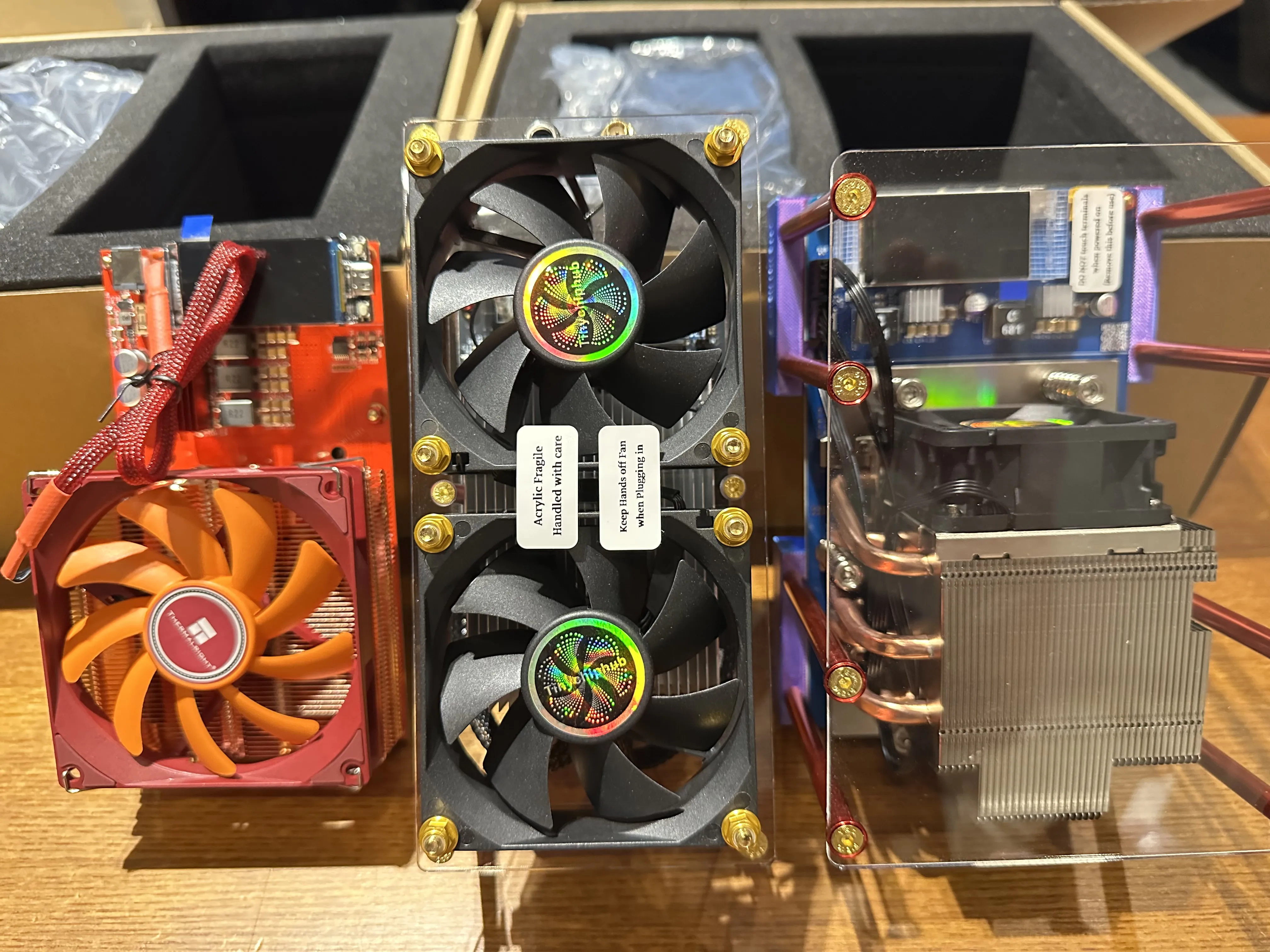
The core point is this: NerdQaxe++ Remastered is not an ordinary upgrade; it's a precise surgical strike targeting the pain points of home miners. Remastered tackles the previously troublesome heat dissipation and noise issues with a cooling solution comprising an Enhanced Fan Cooling Stand, optimized cooling fans, and a 75μm (2OZ) copper trace PCB. Tests show that after 72 hours of continuous operation, the core temperature stabilizes at 65°C (ambient temperature 25°C), with noise controlled at 45 dB, equivalent to the sound of flipping pages in a library. This means you can place it in your study or even the living room, without needing to prepare a separate boiler room for it.
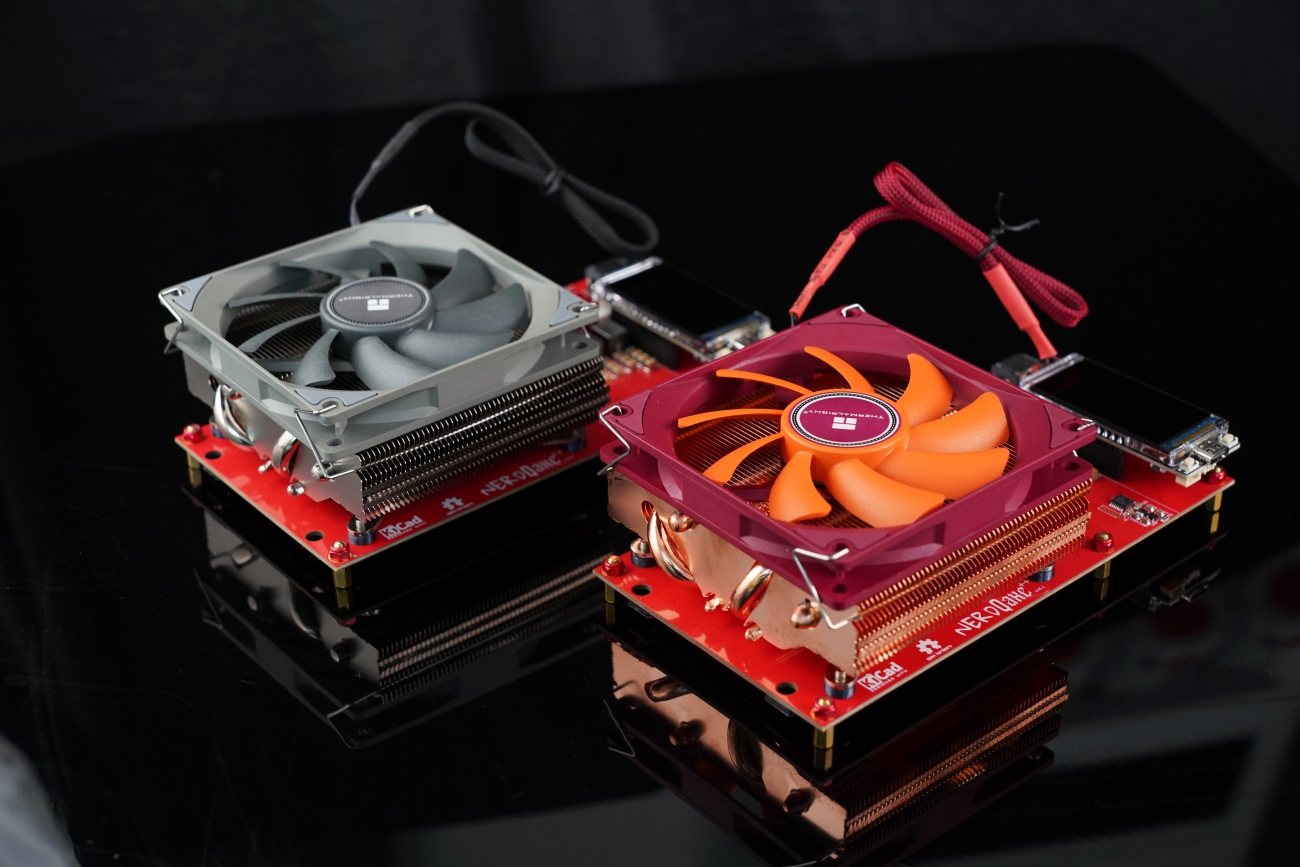
Why is this change so crucial? For home miners, stability and acceptability are far more important than a few percentage points of peak performance. Based on the 2023 Home Mining Insights community report, over 60% of small-scale miners abandoned their equipment primarily due to thermal management disasters and neighbor complaints. NerdQaxe++ Remastered directly targets these two pain points.
- Redesigned Circuitry: Eliminates chaotic "thermal vortex" phenomena and implements solid copper-filled PCB layers that are 4 times thicker compared to the original design, significantly improving heat dissipation efficiency and high-current safety.
- The 2OZ Copper Revolution: Features an ultra-optimized PCB layout with 75μm (2OZ) copper traces, enabling stable 10A input power for overclocking, surpassing the original 8A limit.
- Quantum Cooling Heatsink: Enhanced 32mm solid copper heatsink (optional) with a 0.5mm CNC micro-fin array, integrated with dual-soldered AGHP (Anti-Gravity Heat Pipe) technology, eliminating orientation dependency and maintaining optimal cooling performance in any installation position.
- Optimized Cooling Fan: Provides 42.58 CFM airflow at a maximum speed of 2700 RPM, featuring soft silicone shock-absorbing mounts for ultra-quiet 22.4 dBA operation, with performance comparable to Noctua-grade fans.
- AxeOS-based Interface: Offers the exact same operational experience as Bitaxe, ensuring zero learning curve and seamless user transition.
It's like packing the cooling philosophy of a high-performance gaming PC into a miner. The goal is not to make you compete in a race, but to let it run long-term, quietly, and worry-free, truly integrating mining into the home digital lifestyle.
🗺️Historical Versions? NerdQaxe++
If the evolution of Nerdaxe is compared to a movie, it's definitely a dramatic tale of technological comeback. The first-generation Nerdaxe was like a reckless youth, unable to view its status well. Therefore, building on the first generation, it was upgraded to NerdAxe Gamma by integrating a Lilygo T-Display S3 screen, with a hashrate of 1200 GH/s, supporting Wi-Fi connectivity and silent operation, making it easy to mine at home, officially starting the upgrade journey!!!
Of course, for better comparison and to see the product's strengths and weaknesses, we'll prioritize comparing the air-cooled upgrade direction here, while liquid cooling upgrades outside of air cooling are not compared for now. The real turning point came from various community feedback. Even without overclocking, some NerdQaxe++ miners experienced unexpected burnouts, and most of these were the NerdQaxe++ Rev 5 Miner, leading to two different development directions: Rev 6.1 and Remastered.
Let's elaborate. Rev 6.1 removed the fuse to ensure uninterrupted operation, while adding a more robust XT30 power connector and thicker copper wires to lower operating temperatures. The TinyChipHub Remastered edition, on the other hand, was designed to compete with Rev 6 from the start. It adopted 2-ounce copper layers and PCB rerouting, replaced the 8A fuse with a 10A fuse, and included an adapted power supply and an enhanced fan cooling bracket to further ensure safety. The journey evolved from brute-force hashrate stacking, to pursuing energy efficiency balance, and finally to embracing community wisdom, achieving a unity of stability and playability.
| Core Version | Nominal Hashrate | Key Improvements |
|---|---|---|
| NerdAxe Gamma (First Gen Upgrade) | 1.2 TH/s (Base) | Wi-Fi connectivity, silent operation, equipped with BM1370 ASIC chip |
| NerdQaxe+ | 2.5 TH/s | Integrated four BM1368 ASIC chips |
| NerdQaxe++ Rev 5 | 4.8 TH/s (Overclocked) | High-speed fan, upgraded to four BM1370 ASIC chips |
| NerdQaxe++ Rev 6.1 | 6 TH/s (Overclocked) | Fuse removed, XT30 power connector, thicker copper wires |
| NerdQaxe++ Remastered | 6 TH+/s (Overclocked) | Upgraded 10A fuse, new PCB with 75μm copper traces, front/back cooling bracket design, etc. |
Each version corresponds to the different needs of miners at the time, reflecting the manufacturer's shift from working behind closed doors to growing together with users. Understanding this history helps you see why the current Remastered edition is designed the way it is—it's a culmination of all past "pitfalls" and "highlights."
Parameters!Different Versions⚙️
The parameter table is not for putting you to sleep; it's your "battle map." The parameter differences between NerdQaxe++ versions directly determine your deployment strategy and expected experience. Don't just look at the biggest number for hashrate; the power efficiency ratio (J/TH) and supported network protocols are the hidden deciding factors.
Taking the Remastered edition as an example, its default power consumption is 80W with a hashrate of 5.2 TH/s, resulting in an energy efficiency ratio of approximately 15.83 J/TH. This figure places it in the top tier for home-grade miners, but the secret lies in its dynamic power management. You can set different modes in the backend. For instance, in "OC mode," the hashrate can climb to 6 TH/s with power consumption increasing to around 95W, suitable for daytime operation. Conversely, the "Silent Mode" pushes the fan and chip voltage to the lower calibration limits.
- Determine your power grid and heat dissipation limits: First, check if the circuit where you plan to place it can handle a continuous 100W load, and if the environment has good ventilation.
- Match your mining strategy: If you pursue 7x24 stable operation, then power efficiency and thermal parameters are more important than peak hashrate; if you enjoy tinkering, then firmware playability and overclocking headroom are key.
- Pay attention to compatibility and future-proofing: The Remastered edition not only enhances communication security but is also prepared for potential future mining protocol upgrades.
🔥 Core Tip: Never run a miner directly on your main living circuit. Use a separate dedicated circuit and consider equipping a voltage stabilizer to guard against voltage fluctuations. This isn't for "mining more," but for "not blowing up."
🚀Innovation + Overclocking~~
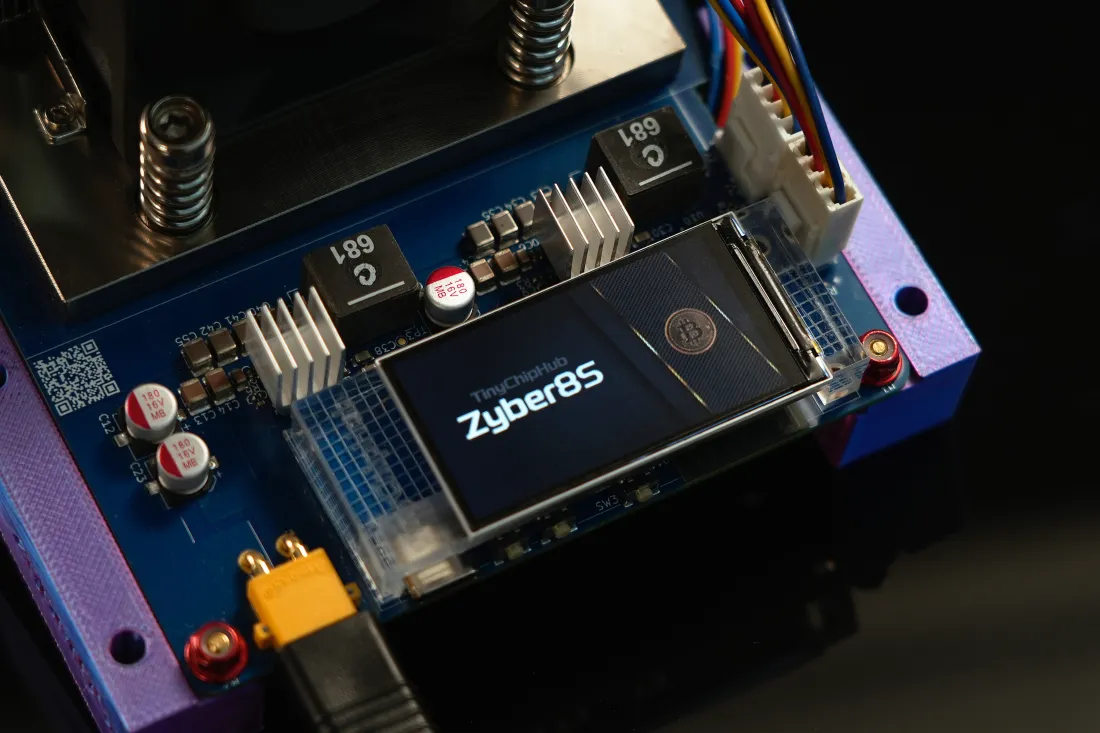
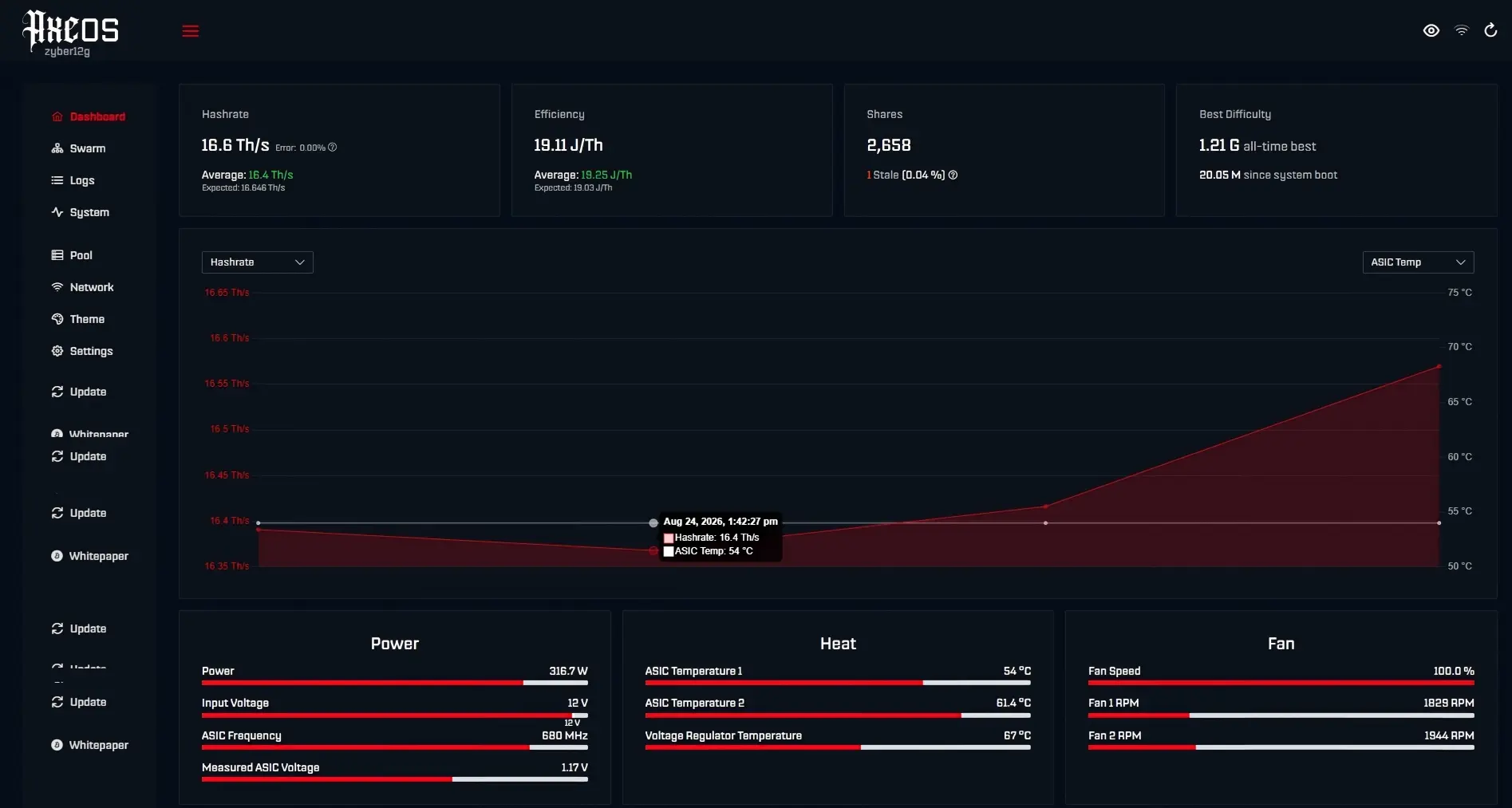
Overclocking is not mysticism; it's a "polite excavation" of hardware potential. The innovation of the NerdQaxe++ Remastered lies in the fact that TinyChiphub provides you with an overclocking "playground" and "safety rails." It fully unleashes the potential of its four BM1370 ASIC chips. The AxeOS-based display interface allows real-time monitoring of voltage, temperature, and hashrate fluctuations, preventing you from accidentally bricking the device.
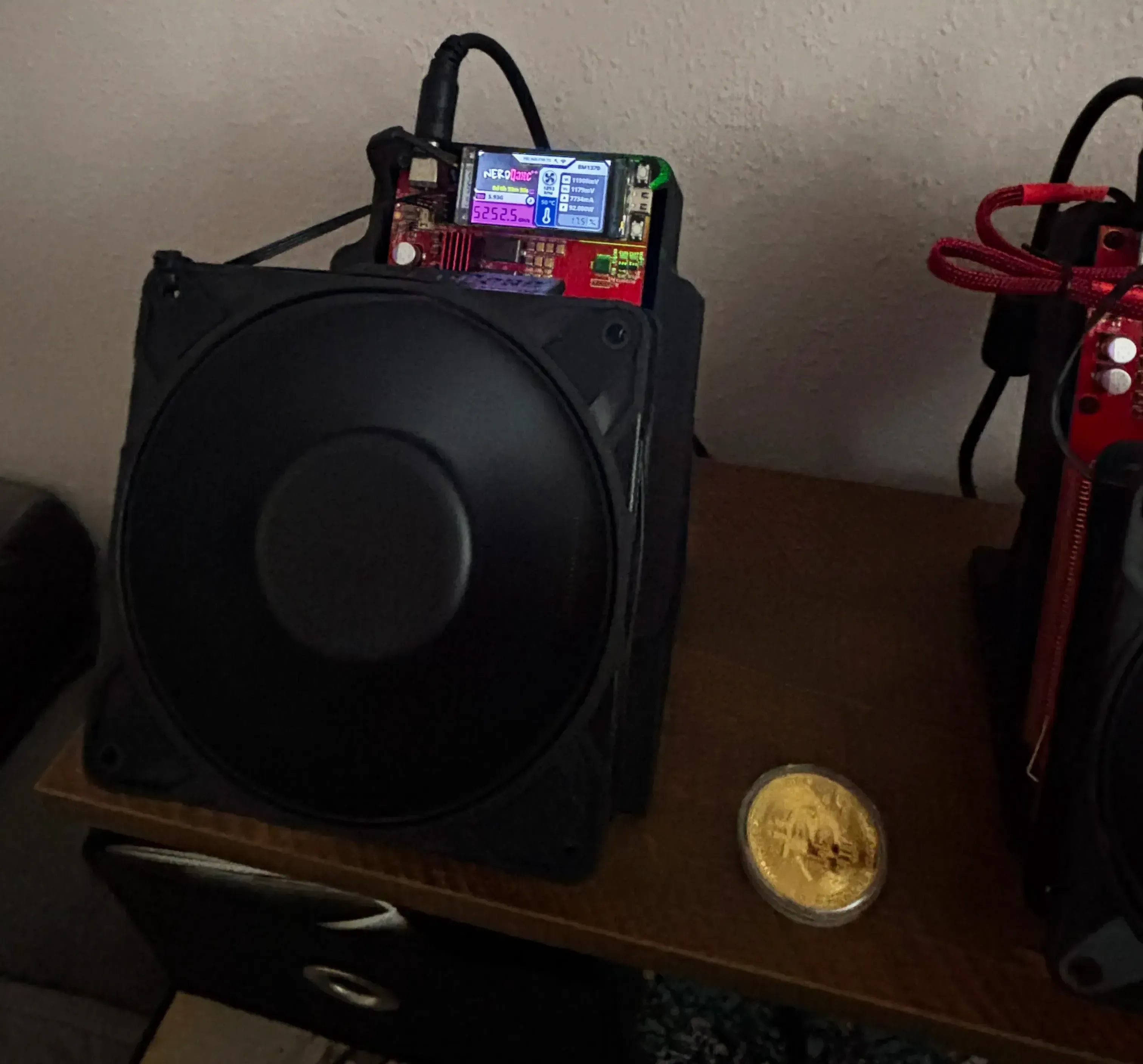
The real innovation is that based on the REV6 version, the NerdQaxe++ Remastered represents the ultimate evolution of the original design. Meticulously crafted by Tinychiphub, it breaks through thermal limits by filling solid copper in the PCB layers and unleashes unprecedented hashrate through revolutionary circuit innovations. For example, tests on the CK pool in OC mode: sustained hashrate (24-hour average) is about 5.2Th/s , with peaks exceeding 6Th+/s, while maintaining power consumption around 95W. At the same time, for safety reasons, we retained and upgraded the original fuse, hence continuing to use the barrel power connector (and providing an optimized 12V-10A lab-grade power supply~), rather than an XT30 power connector.
Three Steps for Safe Overclocking!
Step One: Information Gathering. Find the "constitution report" corresponding to your device's batch number on the official forum to understand the average chip potential.
Step Two: Software Tweaks First. In the web management interface, use the sliders to gradually increase the core frequency, in increments of 5MHz, and observe stability for 24 hours after each adjustment.
Step Three: Hardware Mods with Caution. Only consider fine-tuning voltage via physical jumpers after making absolute cooling upgrades (e.g., liquid cooling + air cooling modifications).
Remember, the goal of overclocking isn't to set world records, but to find the sweet spot between stability, longevity, and performance in your specific environment. The sense of control and the puzzle-solving fun this process brings is far more addictive than the numbers jumping on the hashrate chart. It's like tuning a high-performance race car to perfectly adapt to your driving style and track conditions.