💡 Tip: The following article data is for reference only. Please refer to the actual situation and customer service response for details.
The screwdriver was invented over 500 years ago (around the 15th century), but even today, over 90% of American households have at least one in their toolbox. Calling it a "living fossil" among hand tools is no exaggeration! Now, a comprehensive home screwdriver set can cover over 95% of the screw interfaces found in consumer electronics and small household appliances. This combination set is specifically designed to tackle those everyday "little troubles": from phones (screw specifications like T3, T5, PL5) to laptops (commonly using T5, T6), and even your slipped glasses (PH000 or SL1.2).
Precision Screwdriver: Detailed 🔍
To better distinguish between a screwdriver and a precision screwdriver, let's first understand the former! A screwdriver is a manual or power tool used to drive screws. Today, there are many types of screwdrivers to meet different needs, but they generally serve the same function. A universal screwdriver mainly consists of three parts: the handle, the shaft, and the head.
Basic Structure
-
Handle: The screwdriver handle is for gripping. Handles are usually made of hard plastic or rubber. A good screwdriver handle should be soft and ergonomic for comfortable holding.
-
Shaft: The screwdriver shaft is typically made of hard steel so it doesn't bend when moving or driving screws. The shaft is usually round or hexagonal.
-
Tip or Bit Head: Some screwdrivers have a tip that is integrated with the shaft and is not interchangeable. However, some screwdrivers have interchangeable bits. For example, a precision screwdriver set contains many interchangeable bits to meet different needs. These bits are designed to drive different types of screws.
What is a Precision Screwdriver?
A precision screwdriver is a hand tool that functions the same as a standard screwdriver but is designed with a smaller drive head and a slimmer handle. Precision screwdrivers are also known as jeweler's screwdrivers or mini screwdrivers. Unlike standard screwdrivers, precision screwdrivers are typically used for small, delicate devices like watches, mobile phones, and laptops.
It is essentially a micro-operation system designed for a millimeter-scale battlefield. Your fingers transmit 0.15 N·m levels of precise torque through an ergonomic handle, down a hard steel shaft, to the tip of a bit with a hardness of up to HRC 58-62 (Rockwell hardness) and a machining tolerance of less than ±0.05 mm, allowing it to perfectly engage and turn without damage the slot on a screw that may be only 0.3 mm wide.
For example, take the brand Nanch (the same one used by TinyChipHub engineers in their mining rig repair videos). Why is it recognized in professional circles?
-
Its S2 alloy steel bits maintain a stable hardness of HRC 60-62. According to third-party wear tests in 2025, after continuously removing 100 M1.6 stainless steel screws, tip wear was < 0.08 mm, whereas ordinary bits would have been ruined long before.
-
The strong magnet built into the handle can stably adsorb an M1.4 screw weighing 1.2 grams, preventing it from falling into a mining rig motherboard and causing a short circuit.
-
The entire tool set is designed to comply with hand screwdriver standards, and its coverage of screws commonly found in mining rigs (such as PH0, T8, T10) can reach 100%.
Simply put, an ordinary screwdriver is about brute force, while a precision screwdriver is about skill. Every millimeter and every point on the Rockwell hardness scale in its parameters is meant to handle those delicate objects with near-zero tolerance for error.
🔥 Important Notes: Before each use, check that the connection between the screwdriver handle and the bit is secure, and inspect the bit for wear, deformation, or damage to ensure the tool is in good condition. Never perform any live electrical work, and never use a screwdriver as a pry bar, chisel, or hammer!
Overview of Types & Bit Heads 📦
Bit Heads are the ammunition for this "precision force," mainly divided into two camps: Standard Bit Heads and Specialty/Tamper-Resistant Bit Heads. Standard bit heads handle open products, while tamper-resistant bit heads are specifically designed to attack those devices that "don't want you to open them," like certain brands of game consoles or smart speakers.
-
Phillips (PH): This screwdriver was invented by Henry Phillips in the 19th century, but sizes vary greatly. PH000 (approx. 1.5mm) is used for repairing glasses legs, PH0 (approx. 2mm) for disassembling phone casings, PH1 (approx. 3mm) for tinkering with routers. Remember, always use the size that fits the slot perfectly, otherwise you risk stripping the screw head instantly.
-
Slotted or Flat-head (SL): Antiquated but still going strong. The blade of a precision slotted bit heads must be straight as a line, with common thicknesses of 0.4mm, 0.6mm, used for adjusting old-fashioned potentiometers or opening nail clippers.
-
Torx (T): The "specialized lock" of modern digital products. From T2 to T10, they are ubiquitous in Apple products, hard drives, drones, etc. Its six-point star design distributes torque evenly, greatly reducing the risk of stripping. Here's a lesser-known fact: many T bit heads are also compatible with their corresponding tamper-resistant version, TR (with a center pin).
-
Hex/Allen: These are also called Allen keys. Specifications like H1.5, H2.0 are regulars for assembling IKEA furniture, adjusting bicycle disc brakes, and 3D printers. Hex screwdrivers are specifically used for tightening or loosening hexagonal bolts or screws. This type of screwdriver allows for quick disassembly and tightening of screws.
-
Specialty/Tamper-Resistant Bit Heads: This is where true capability is demonstrated. Tri-point, Pentalobe, and Spanner (U-shaped) bit heads are the "keys" to opening specific brand phones, laptops, and game consoles. For example, iPhones from the 5s to the 13 series have consistently used Pentalobe screws on the bottom.
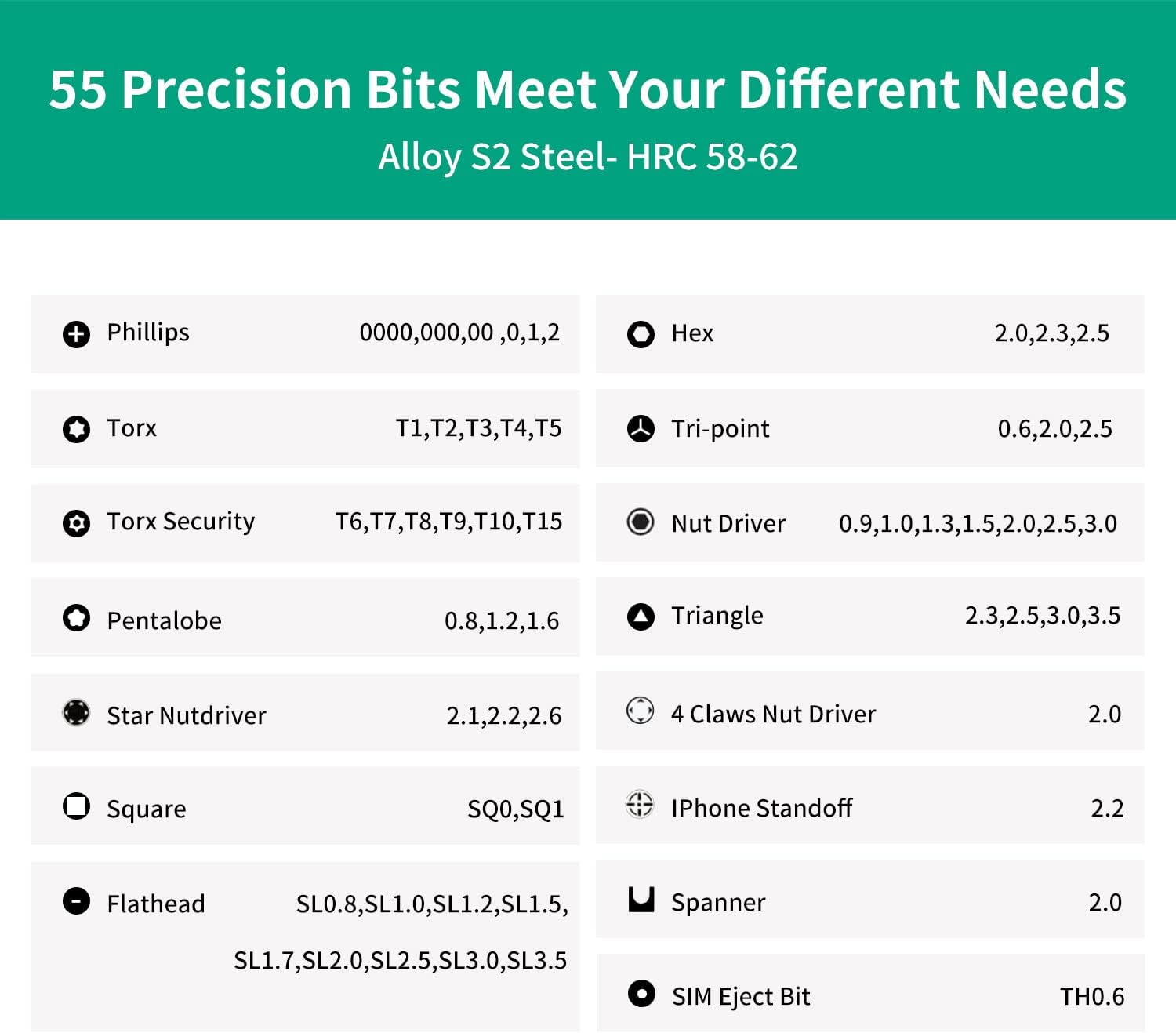
Material is the soul. Don't just look at the quantity; see what steel it's made of, i.e., the material used. Currently, it is recommended that the bits in the Nanch precision screwdriver set uniformly use S2 alloy tool steel, which balances hardness and toughness. A 2024 review in "Tools Journal" compared the wear of three material types after continuously driving 100 M2 stainless steel screws. S2 steel bit tip deformation was <0.1mm, while low-quality carbon steel bits had worn over 0.5mm, essentially ruined.
✅ Buying Guide: Key Factors
The essence of selection is solving the problem of "tools not being suitable leading to repair rollover with the nerdqaxe++ bitcoin solo miner." Don't be fooled by fancy bit counts; the core is covering high-frequency scenarios + key quality metrics. You need to focus on these hard indicators; they directly determine whether your operation is a miraculous restoration or a disaster scene!
-
Core Bit Lineup (20-30 pieces are sufficient): Must cover PH0/PH00, T3/T5/T6/T8, SL1.5/2.0, and the specific tamper-resistant bits for your devices (e.g., PL5).
-
Material and Hardness: Look for "S2 Alloy Steel" or at least "HRC 58+" in the product description. For a good set of bits, 60% of the cost is in the material.
-
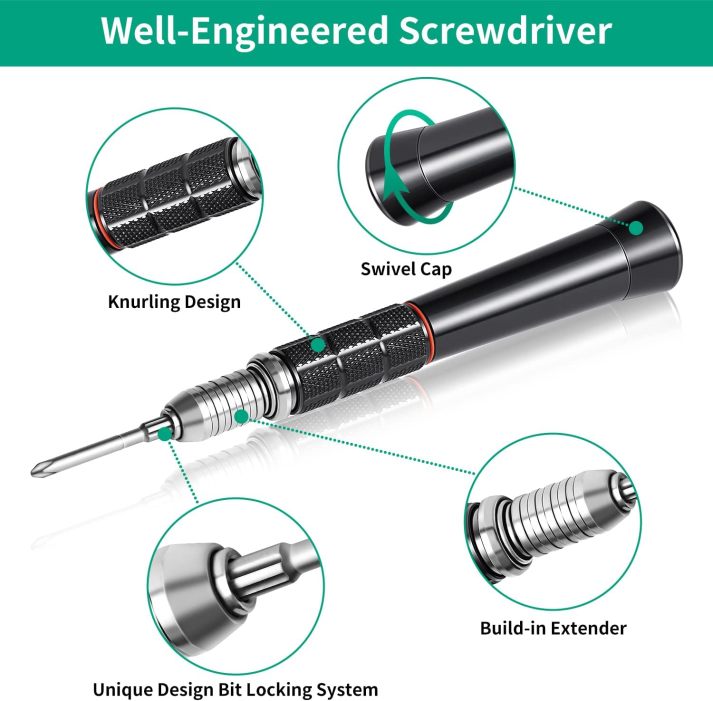
Handle Ergonomics and Torque: Handle diameter should be 8-10mm, with anti-slip knurling. A rotating end cap is a standard feature on high-end models. The handle interior should have a bearing for smoother rotation. For example, the Nanch H1B screwdriver features a knurled grip design and is sealed and cut to ensure aesthetics and anti-slip properties.
-
Magnetism Must Be Strong and Switchable: More professional handles have a magnetic ring slide switch. Magnetism must be turned off when repairing mechanical hard drives to prevent magnetizing the platters. The recommended screwdriver also comes with a magnetizer. You can magnetize or demagnetize the chip as needed; your microchip won't fall off anymore.
-
Storage Case Organization Logic: Bit slots must have clear labels, organized by type and size.
❌ Common Pitfalls: Avoid those "gift sets" with bits plated gold or in colorful colors. The plating increases dimensional tolerance and is not wear-resistant. According to guidance from the U.S. Consumer Product Safety Commission (CPSC), household hand tools should avoid using lead-containing coatings. Look for well-known brands or OEM products from professional tool manufacturers, which usually have more reliable quality control and comply with international standards like ISO 2351.
🔧 Sets & Application Scenarios
The scenario determines the configuration. Different sets prepare for different "battlefields." Precision screwdrivers are smaller and lighter than ordinary screwdrivers. A precision screwdriver set usually comes with a storage case containing various interchangeable bits. A good precision screwdriver can effectively solve various problems, such as repairing smartphones, game consoles, watches, glasses, and even drones. If you are an Apple fan, a precision screwdriver set can help you easily handle Apple products, including Apple Watch, Apple Vision Pro, iPhone, and laptops.
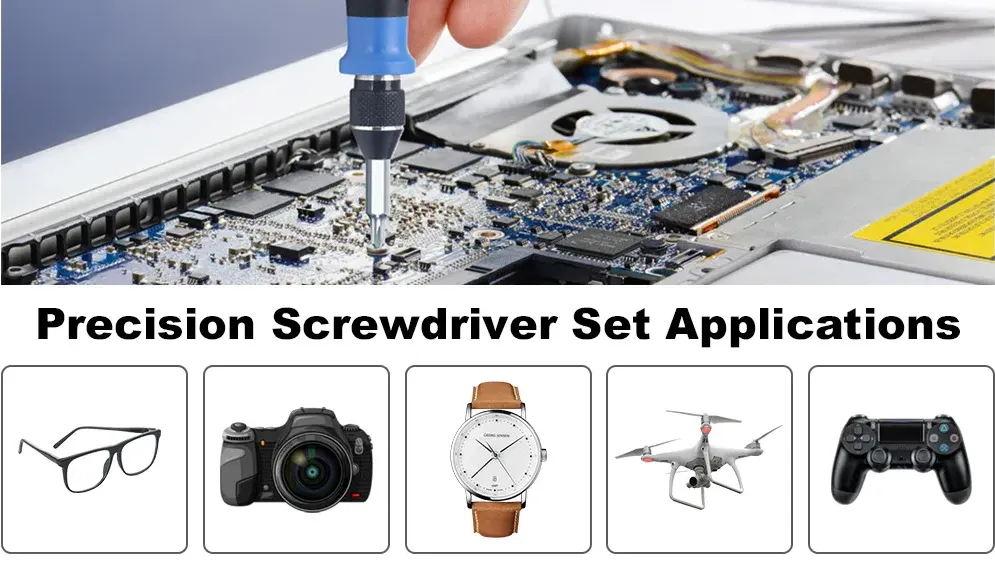
To disassemble a 2018 MacBook Air to replace the battery, you need: Pentalobe PL5 (to remove bottom case screws), T5 Torx (to disconnect the battery connector), Phillips PH1 (to remove mounting brackets). All bits in this set are S2 steel, with adjustable magnetism. Particularly, the handle with an extension rod and a flexible shaft is invaluable for operational flexibility in densely packed motherboard areas (where component gaps might be only 2mm). iFixit gave it a 9.5/10 in their 2025 Pro Tech Toolkit review, with a key scoring point being its 95% bit coverage rate for the latest ultra-thin laptops.
💪 Configuration Suggestions
| Your Profile | Recommended Set Size | Core Bit Needs | Investment Budget (USD) | Key Considerations |
|---|---|---|---|---|
| General Home User | 24-32 Piece Set | PH, SL, Common T Series | $20 - $40 | Convenient storage, comfortable handle feel |
| Tech Enthusiast/Geek | 54-64 Piece Set | Full coverage of PH, T, Various Tamper-resistant bits (PL, Tri), plus extension rod | $50 - $100 | Bit material (S2 steel), switchable magnetism, warranty policy |
| Maker/Hardware Hobbyist | Main Set + Supplementary Individual Bits | Based on main set, supplement with H series (1.5-3mm) and specific size Torx | $80+ | Handle torque range (e.g., 0.1-3 N·m), replaceable components (e.g., flexible shaft) |
When you're playing with DIY mini mining rigs or adjusting a 3D printer, you'll face M2.5, M3 standoffs and hex screws. Here, a set containing H1.5, H2.0, H2.5 bits, with a longer handle (providing greater torque), comes in handy. I often use it to tighten screws on GPU brackets (Torx T8) or adjust fixing posts on mining rig control boards (Hex H2.5). Note: For industrial scenarios involving long-term, repetitive use, it is recommended to purchase additional individual high-quality bits of the corresponding sizes, as the bits in a set, while comprehensive, have individual limit life that can be a shortcoming under professional high-frequency use.