💡 Tip: The following article data is for reference only. Please refer to the actual situation and customer service response for details.
Within about a week (starting from the day after April Fool's Day, April 2nd to April 9th, 2026), four BTC solo miners consecutively found blocks! So, what happens when a block is found: The miner directly and completely wins the entire block reward (approx. 3.125 BTC) + transaction fees, with average individual earnings from these block finds exceeding $200,000.
In the bear market competition, the lottery jackpot event of an individual miner finding a block, an extremely low-probability occurrence, actually increases! Just configure a solo miner once, and you have a chance to gain returns far exceeding 10,000 times your daily income. It's indeed worth a try. ($200,000 Vs. $1~$20)
Block #943,411
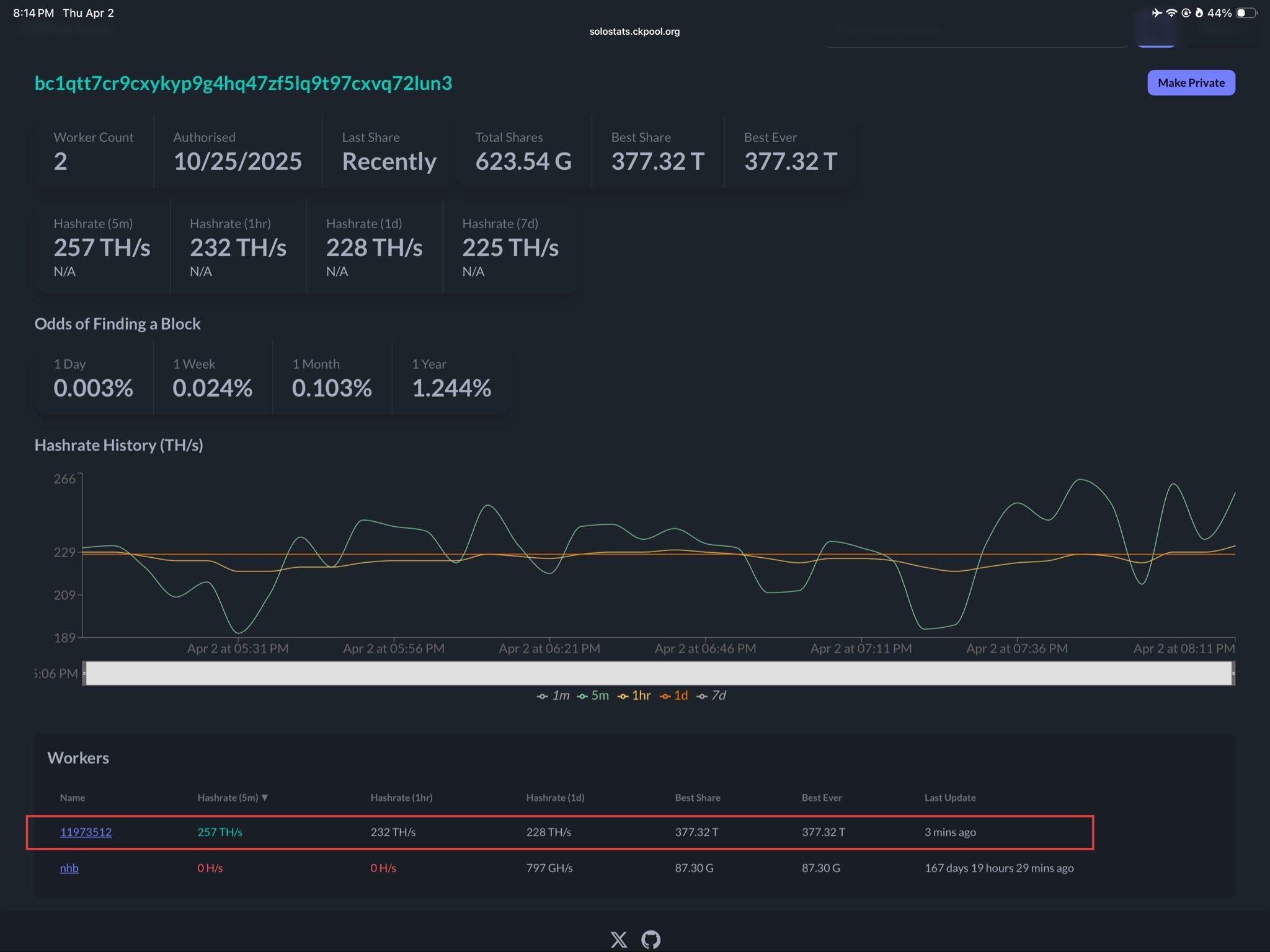
The first "Block Found!" in April was like a beginner's luck bonus from the system, hitting epic luck with hashrate similar to an Antminer S21+ (approx. 230 TH/s). According to ckpooldev's report on X: "A miner of this size has about a 1/28k daily chance of solving a block! Congratulations to miner bc1qtt7cr9cxykyp9g4hq47zf5lq9t97cxvq72lun3 for solving the 312th Solo block on solo.ckpool.org with ~230TH hashrate!" If it had been solved one day earlier, we'd really suspect it was an April Fool's Day event!

Let TinyChipHub lab break down this process! The mechanism of solo mining is simple: your miner works independently to solve the cryptographic puzzle. Once it takes the lead in calculating a hash value that meets the difficulty target, you take the entire block reward (3.125 BTC + fees). According to Bitcoin Wisdom network data from April 2024, with a network hashrate of about 650 EH/s at that time, a miner with 100 TH/s would take an average of about 4 years to mine a block. But note, this is "average" time; the probabilistic "waiting time" could be very short or very long. That's the essence of gambling on luck.
This process involves several key protocols. The SHA-256 hash algorithm is the core competition of mining, while the Stratum protocol is the bridge for communication between the miner and the Bitcoin network (even for solo mining, you need to broadcast the block via a node). For home miners, ensuring your node is synchronized and your network has low latency is crucial to not fall behind in the split-second race of block propagation. Want to replicate this luck? First, ensure your mining software is configured for solo mode and connected to your own, fully synchronized Bitcoin Core full node.
❓ Risk Warning: Solo mining means extremely high variance in earnings. You might get nothing for months or even years, testing both equipment and mentality. It's recommended to only try with redundant or idle hashrate.
Block #943,466
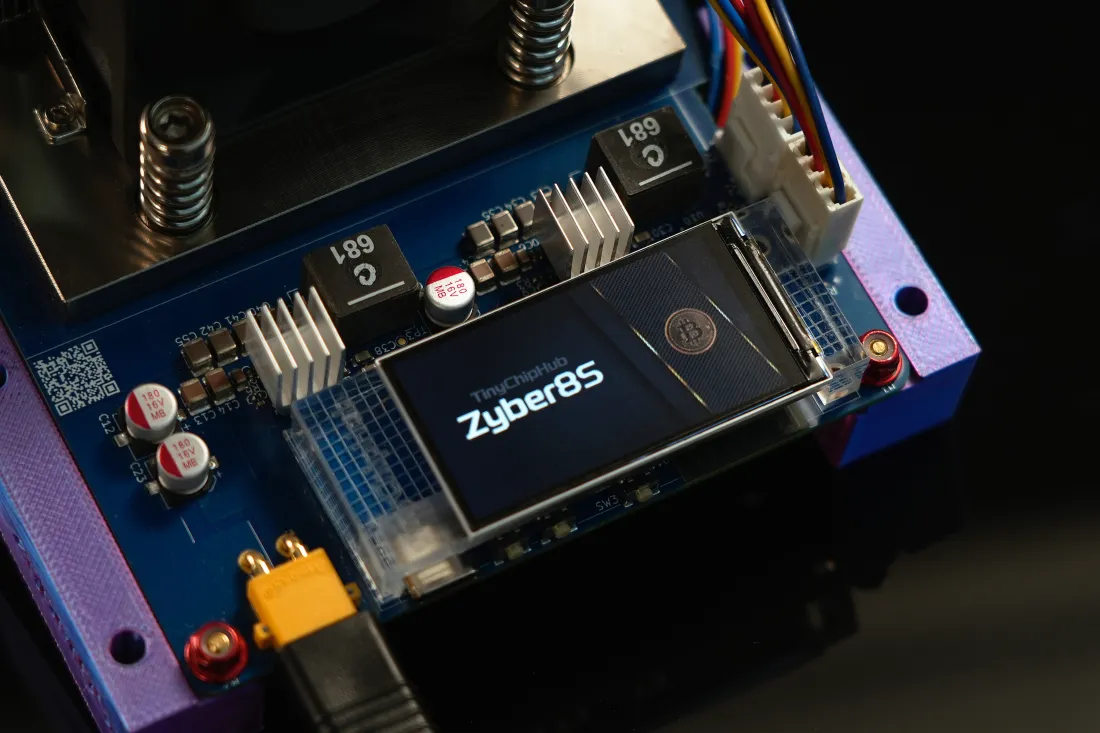
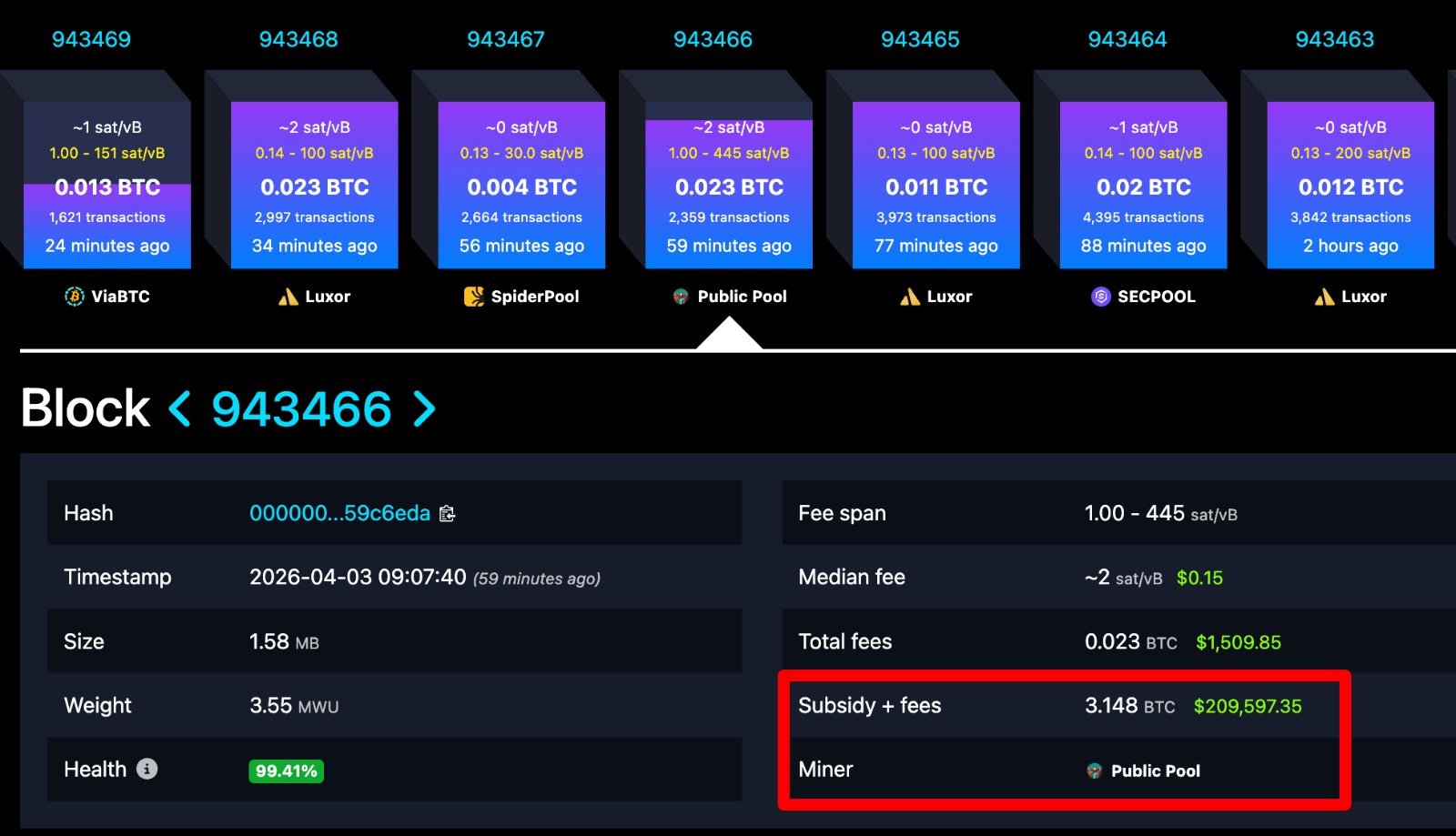
If the first block was a occasional occurrence, then Block #943,466 found just about 12 hours later (9 AM on April 3rd) was a super surprise! An NerdOctaxe miner with 9.6 TH/s (comparable to Zyber 8G) found a block on a network with 996 EH/s hashrate. This was the first block found since the product launch, with its hashrate accounting for only 0.00000096% of the network, earning nearly 3.148 BTC worth of Bitcoin. The finder of block #943,466 also overcame a massive difficulty of 2.86P, marking a milestone victory for the NerdQaxe series miners! Furthermore, since this was the first block completely mined by the public pool (Public-pool.io), this single block directly created two historic "firsts".
(Note: Previous blocks from Public-pool.io were from self-hosted instances of various nodes, not completely from the pool itself.)
Blocks Found by Public-pool.io
- Block #888,989 (March 23, 2025)
- Block #920,440 (October 23, 2025)
- Block #928,985 (December 22, 2025)
- Block #937,218 (February 18, 2026)
- Block #943,466 (April 3, 2026) =》 The only solo-mined public pool block
Since July 2024, open-source home mining hardware has recorded 6 independent block finds so far. One was a Bitaxe Supra with 500 GH/s, another was a Bitaxe Ultra with 0.48 TH/s. As more devices come online globally, the interval between block finds is constantly shortening.These miners are not profitable in the traditional sense. Their daily running cost is only a few cents. But the block reward is 3.125 Bitcoin. This asymmetry is the key point.
Block #944,078
Just when everyone thought luck had run out, Block #944,078 arrived on April 7th! It felt like playing dominoes, touching some switch that kept triggering blocks until the next one was yours.Everyone wondered, what are the odds? The answer: an extremely low probability event far below 0.0000001%, truly no less than being struck by lightning twice!
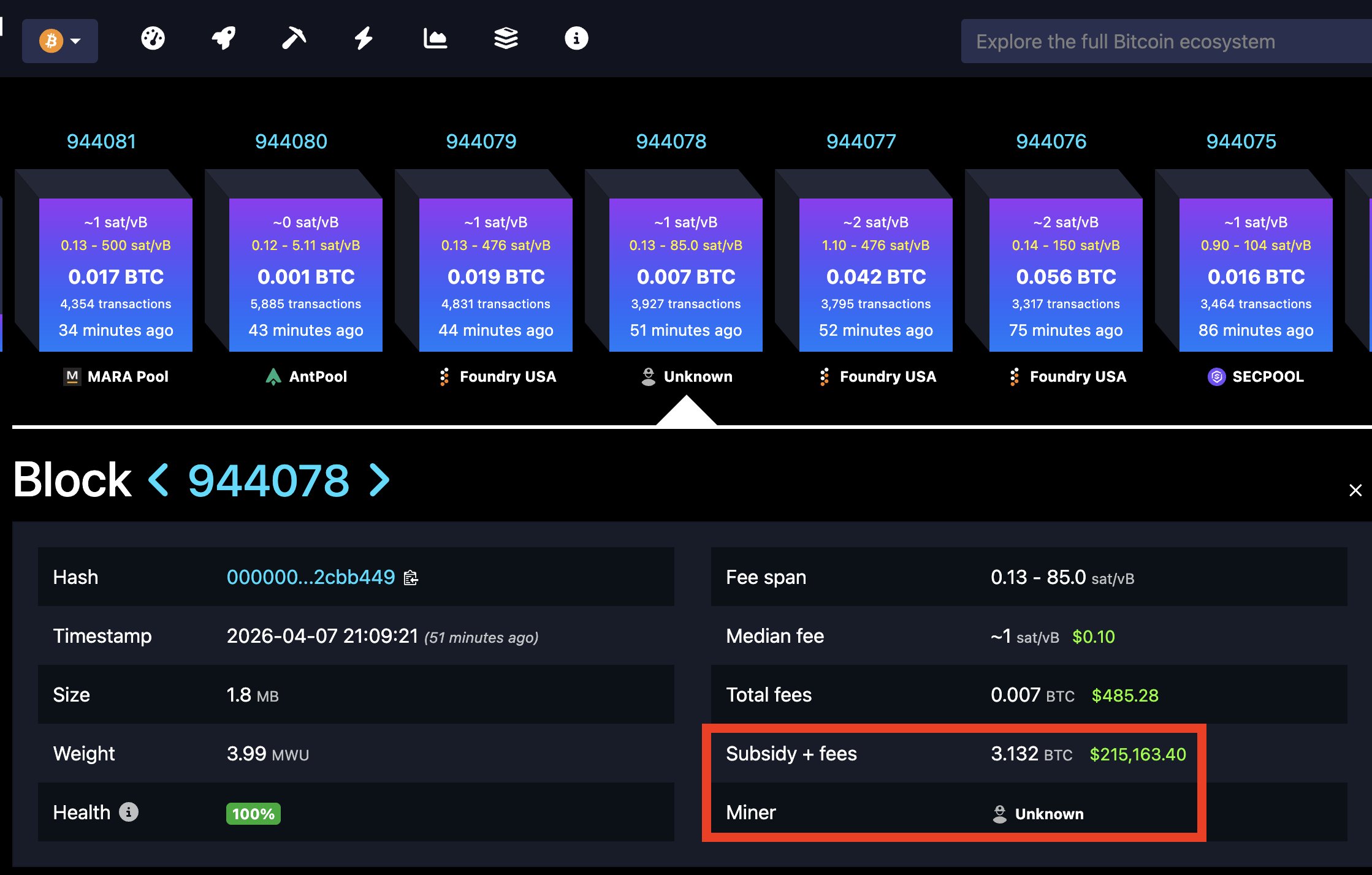
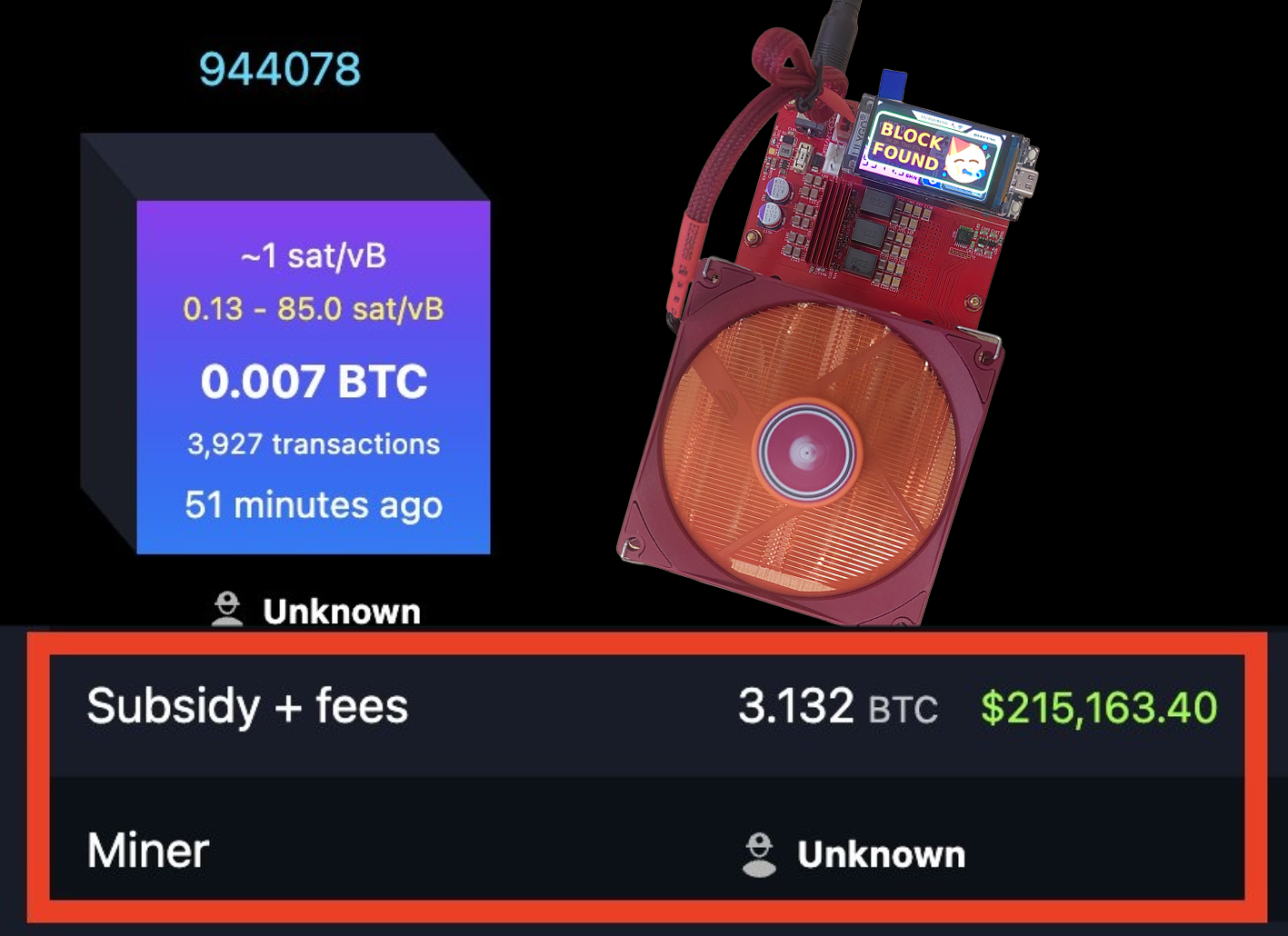
This was the third independently mined Bitcoin block in a week! A NerdQaxe++ miner (with a 24-hour average hashrate of 4.8 Th/s, thus preliminarily identified as from this series) mined Block #944,078 on the Noderunners pool.The block contained 3,927 transactions with a total reward of 3.132 BTC (3.125 BTC subsidy + 0.007 BTC fees). At the time of discovery, Bitcoin was trading near $69,500, making the reward worth approximately $217,700.
Block #944,078 Miner Stats (Noderunners Dashboard)
| Metric | Value |
|---|---|
| Worker Name | NerdQaxe++ |
| Hashrate (1-minute) | 6.53 TH/s |
| Hashrate (5-minute) | 5.43 TH/s |
| Hashrate (1-hour) | 4.97 TH/s |
| Hashrate (1-day) | 4.82 TH/s |
| Hashrate (7-day) | 4.67 TH/s |
| Last Share | 2026-04-07 21:01:06 |
| Total Shares | 13.89G |
| Best Share | 217.1T |
| Best Ever | 217.1T |
| Network Difficulty | 138.97T |
This Solo miner successfully mined the block with a block difficulty of 217.1T, far exceeding the network average difficulty of 138.97T. This also marks the first confirmed independent block find by a NerdQaxe++ miner, which can be counted as the third Bitcoin block discovered by the NerdQaxe++ series. Of course, similar miners have found blocks before, but those were either proportional pool payouts (e.g., Block #913,272) or part of a six-miner cluster with an Avalon Q miner (e.g., Block #920,440).
This is the seventh recorded block discovered by open-source home mining hardware. This list continues to grow~~~
-
New Block #944,078 (April 7, 2026): NerdQaxe++, ~4.8 TH/s, Noderunners pool
- New Block #943,466 (April 3, 2026): NerdOctaxe, ~9.6 TH/s, Public pool
-
Block #924,569 (November 21, 2025): Bitaxe Gamma 602 cluster, ~5.4 TH/s, CKPool
-
Block #920,440 (October 27, 2025): NerdQaxe++ Rev 6 cluster, ~6 TH/s, Public pool
-
Block #913,272 (September 5, 2025): NerdQaxe++, ~4.8 TH/s, Ocean Mining (pool), Proportional pool payout
-
Block #887,212 (March 10, 2025): Bitaxe Ultra, ~0.48 TH/s, CKPool
-
Block #853,742 (July 24, 2024): Bitaxe Supra, ~500 GH/s, CKPool
🔥Reminder: The miner is marked as "Unknown" on mempool.space, consistent with mining via a small pool that hasn't embedded an identified Coinbase tag.
Block #944,306
Block #944,306 perfectly concluded this legendary week. The fourth Block Found! This has transcended technical discussion and feels like entering the realm of metaphysics. This series of events was like a perfect stress test, practically demonstrating that under the current ultra-high difficulty, individuals still have significant opportunities to participate in the Bitcoin network. Bitcoin mining is like a giant lottery, with a draw about every 10 minutes, and here, one miner won 3.128 Bitcoin.

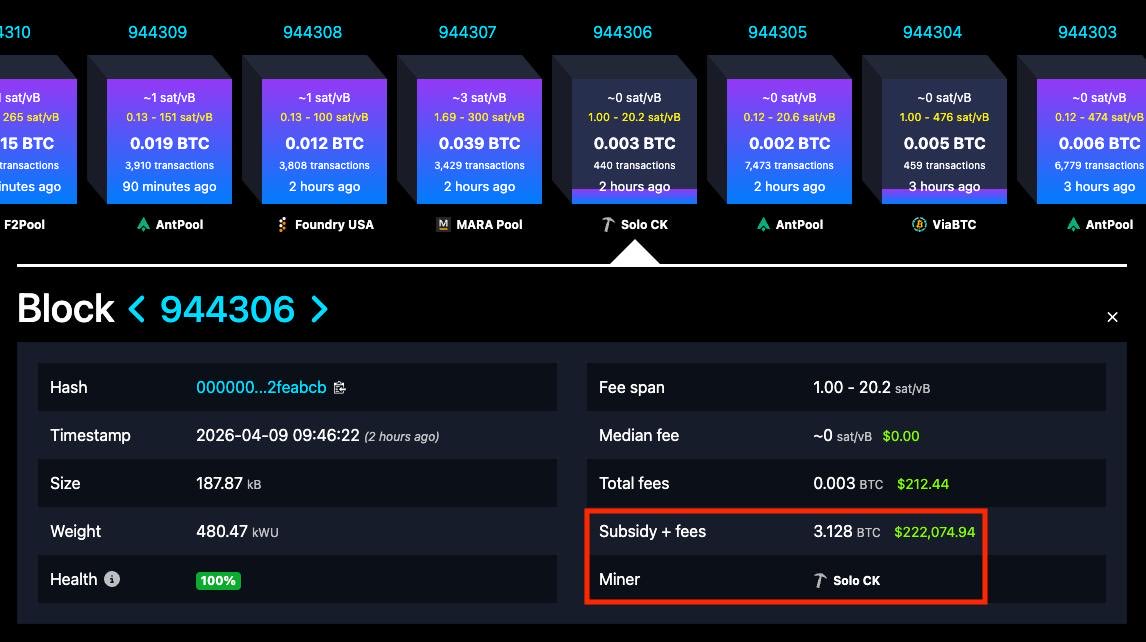
This was the 4th solo Bitcoin block in one week (April 2nd~9th), and the final one! On April 9, 2026, an individual miner using a miner similar to an S19 discovered Bitcoin block 944,306 worth 3.128 BTC (approx. $220,000) on the CK Pool. The block contained 440 transactions with a fee of 299.2k sats!
No large mining pools, just his own machine competing directly against the entire Bitcoin network (total 971.1 EH/s). Winning solo also means keeping 100% of the prize, no fees to pay, no sharing with others. High risk, high reward.The average hashrate over the past 24 hours was 55.9 Th/s. Equivalent to:
=》25 Bitaxe GTs
=》50 Bitaxe Gammas
=》12 NerdQaxe++
=》6 Zyber 8Gs
❄️What are the implications for home/small-scale miners?
1) Hardware is the foundation: Focus on energy efficiency (J/TH). New-generation ASIC Miners generally control efficiency within 15-30 J/TH.
2) Cooling is the lifeline: Ensure ambient temperature is below 30°C, consider water cooling or forced air ducts.
3) Network is the lifeblood: Low-latency, high-upload-bandwidth fiber optic network is essential.
4) Persist: Treat solo mining as a "lottery-style experiment" to support the network and learn technology, not as an income source. The "National Electrical Code (NEC)" requires home mining rigs to be connected to dedicated circuits. Safety always comes first. This feast will eventually end, but what it ignites is the flame of "taking control, challenging limits" in every tech enthusiast's heart. 🏃