💡 Tip: The following article data is for reference only. Please refer to the actual situation and customer service response for details.
When your NerdQaxe Miner backend suddenly pops up "Fork Detected," it means the network has discovered two "legitimate" new blocks within almost the same millisecond. Your miner (along with hundreds of thousands of others globally) is facing a temporary, thrilling "choose one" race. This process is typically resolved automatically by Bitcoin's "longest chain rule" within 1-2 blocks (about 10-20 minutes), but it temporarily causes your local node to be out of sync with the global network state.
🔍 Definition and Nature
Bitcoin's "block discovery fork" is not a bug in essence, but a design feature. It is an inevitable, brief "disagreement" in the ledger that occurs when there is physical delay (about 2-12 seconds) in information propagation across a global decentralized network. According to a 2024 report from the MIT Digital Currency Initiative, the Bitcoin network experiences a "natural fork" on average once every 1000 blocks (about 7 days), which is a sign of network health, not a malfunction.
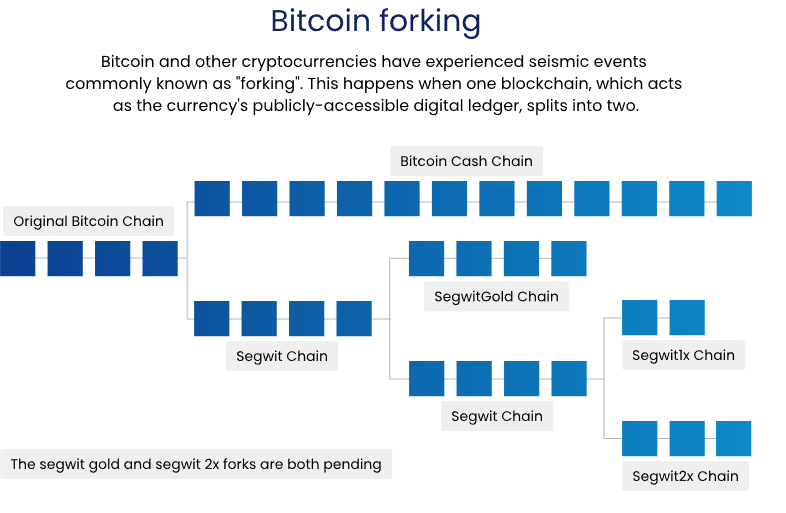
Don't think of it as too complicated. Imagine tens of thousands of 100-meter dash judges (miners) worldwide. Due to different viewing angles from their stands and their own reaction speeds, at the moment the runner crosses the finish line, 49% of the judges might think Runner A won with 9.780 seconds, while 51% of the judges, a few milliseconds later, think Runner B won with 9.779 seconds. In that split second, two "champion versions" are created. The Bitcoin network constantly stages this kind of "photo-finish judgment." When two miners solve the SHA-256 mathematical puzzle (find a valid block) almost simultaneously and broadcast it to the network, due to the physical limits of fiber optic transmission speed (~200,000 km/s) and node processing delays, one part of the network receives Block A first, another part receives Block B first, and the ledger instantly "splits."
This fully aligns with the design expectations of the Nakamoto Consensus. This type of fork is temporary and non-contentious. It is not a "hard fork" caused by ideological differences like Bitcoin Cash (BCH) in 2017. When your miner (like the NerdQaxe Miner running firmware provided by TinyChipHub) detects this situation, it follows the built-in protocol to automatically choose the chain it sees as having the "heaviest proof-of-work" to continue mining. Network latency is the main cause, with an average block propagation time of about 2.5 seconds, but this time can fluctuate to over 8 seconds among global nodes.
🔥 Key Insight: Forking is the "necessary path" for a decentralized network to achieve final consensus. Its brief existence precisely proves the network has no centralized command and is a manifestation of security. The latest Stratum V2 protocol supported by your miner optimizes communication, reducing the probability of you "backing the wrong horse" due to local latency.
⚙️ Causes
The root cause of forking is the collision of an "impossible trinity" in the real world: network physical limits, randomness of hash rate distribution, and uniformity of protocol rules. The interaction of these three turns forking from a probabilistic event into a periodic reality. According to the Coin Metrics Q1 2025 Network State Report, over 65% of natural forks can be attributed to network propagation delays.
Let's break it down:
-
Network Latency: "Traffic Jam" on the Information Highway. This is the number one culprit. The blockchain network is not "instantly synchronized"; data packets need time to travel through global fiber optics. A block mined in Iceland may take 80-120 milliseconds to propagate to a mining farm in Texas, USA. If during this time, a local mining pool in Texas, leveraging stronger hash power (e.g., using better ASIC BOOST optimization), also finds a block, a fork is born.
-
Near-Simultaneous Block Discovery: The "Tie" Moment in the Math Competition. Bitcoin's average block time is 10 minutes, but this is a probabilistic average. In reality, two blocks can be found by different miners within an interval of seconds or even milliseconds. According to historical data, situations where the block interval is less than 30 seconds account for about 12%, which is precisely the high-incidence window for forks. The higher your miner's hash rate (like the actual measured hash rate of the NerdQaxe Bitcoin Solo Miner), the more times you participate in this "millisecond race," and the more frequently you "experience" forks.
-
Protocol & Client Behavior: "Subtle Differences" in Rule Interpretation. Although all nodes follow the Bitcoin Core protocol, different clients (like Bitcoin Core) or nodes of different versions may have extremely subtle differences in edge-case rules like transaction ordering and mempool handling. Under extreme coincidence, this can lead to divergent judgments on block validity, triggering a fork. Ensuring your mining software and node client are up-to-date and have passed radio compliance certifications like CE (EU) or FCC (USA) is fundamental to reducing such anomalies.
When network conditions are good (average latency <2 seconds), the natural fork rate is below 0.5%; when there is local congestion or attacks on the global network causing increased latency, the fork rate can temporarily surge to over 2%. This is why large mining pools invest heavily in building dedicated fiber optic networks to compress propagation time to the extreme.
🔄 Types of Forks
Not all forks are the same. Extending from the point of "block discovery fork," we can use the two rulers of "intent" and "compatibility" to clearly delineate the world of forking. Here we mainly discuss "natural forks," but they are often confused with "hard forks/soft forks." According to historical analysis by BitMEX Research, 99% of what miners encounter daily are unintentional, short-lived "natural forks."
First, the table to see the differences clearly!
| Fork Type | Core Characteristics | Planned? | Chain Permanence | What Miners Should Do |
|---|---|---|---|---|
| Natural Fork | Unintentional divergence due to network latency | No | Temporary, usually resolved within 1 block | No action needed, follow the longest chain |
| Soft Fork | Forward-compatible protocol upgrade (e.g., SegWit) | Yes | Permanent, only one chain survives | Upgrade software to support new rules |
| Hard Fork | Forward-incompatible protocol split (e.g., BCH) | Yes/No | Permanent, usually splits into two chains | Choose one chain to support and switch to the corresponding node |
For you running a Bitaxe Miner, the most important thing is to understand that "natural forks" are a technical phenomenon, while "soft/hard forks" are socio-governance events.
-
Natural Fork (Accidental Fork): It is a momentary divergence in network state, with no malice or planning. Your miner might have been mining based on block N-1 a few seconds ago, and the next second it receives both block N(A) and block N(B), both pointing to N-1. At this point, your node will, based on the timestamps it receives and the information from connected peer nodes, choose one chain it considers "valid." This process is fully automated and complies with the node behavior guidelines defined in Bitcoin's BIP (Bitcoin Improvement Proposal) process.
-
Soft Fork & Hard Fork (Planned Fork): These are intentional, purposeful changes to protocol rules. A simple analogy: a soft fork is like "upgrading traffic rules from 'stop at red light' to 'stop at red light, and do not cross the stop line'," where older version cars (nodes) can still drive, though the experience may be degraded; a hard fork is like "mandating all vehicles must drive on the left," where unupgraded cars simply cannot drive on the new road. For example, the 2017 SegWit upgrade was a successful soft fork. Changes like adopting a new proof-of-work algorithm (e.g., changing from SHA-256 to another) would necessarily be a hard fork.
❓ What does this mean for you? As a miner, you only need to focus on natural forks. Seeing one indicates your miner's network connection is normal and it's actively participating in consensus. For planned forks, you need to follow community news and mining pool notifications to decide whether to upgrade firmware (usually the pool handles most of it for you). Choosing hardware like NerdQaxe that can promptly provide firmware OTA upgrades and clear compliance guidance can save you a lot of hassle.
✅ Resolution Mechanisms
The mechanism for resolving natural forks is both brutal and elegant: the "Longest Chain Rule" (or "Heaviest Chain Rule"). This is not a vote, but a silent "taking of sides" by all miners using their hash power, ultimately converging into a single history. A 2023 paper from the Stanford University Blockchain Research Center pointed out that this mechanism probabilistically guarantees that as long as honest hash power exceeds 50%, the network will eventually converge on one chain, and the certainty grows exponentially with the addition of subsequent blocks.
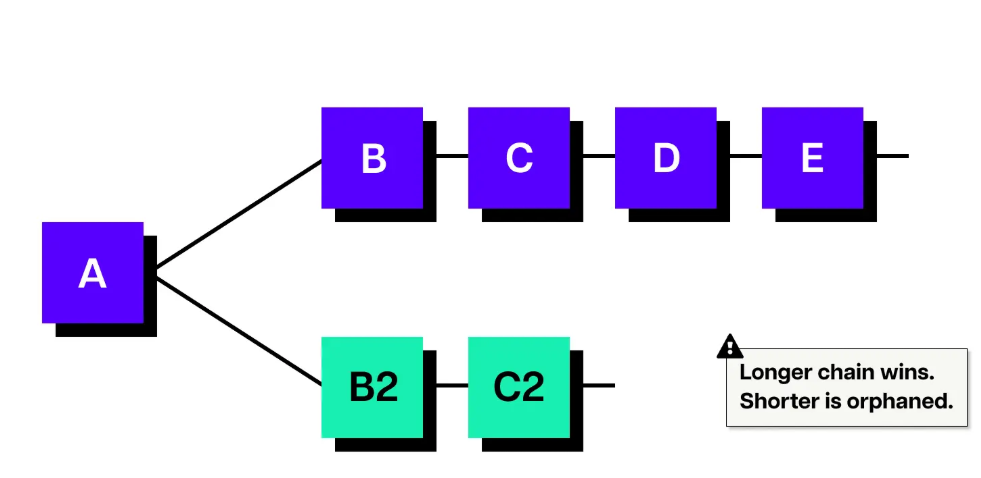
The process mechanism can also be understood through the following flow. You can imagine it as a "tug-of-war between chains"!
1. Mining => Natural Fork => PoW Consensus Mechanism
Mining is essentially a game of probability. Sometimes, two small miners find valid hash values almost simultaneously. When this happens, other nodes in the network have to choose between two different (valid) blocks A and B at the same block height, both referencing the same parent block C, causing the blockchain to fork. Since there can only be one true canonical chain, the PoW consensus mechanism resolves this through the "Longest Chain Rule."
2. Solution: Longest Chain Rule => Identify Canonical Chain => Orphan Block Discarding
The Longest Chain Rule (also known as the "chain with the most proof-of-work") means that when nodes face a blockchain fork, they must always adopt the chain that required the most energy to build as the canonical chain and discard the competing block (orphan block) as invalid. This means that after a fork occurs, miners will eventually find a block D that references one of the two competing blocks at the same height (e.g., block B) and builds a block on top of it. Once this happens, the longer of the two competing chains (C>A and C>B>D) will win and be considered the canonical chain by the network. In this example, the C>B>D chain has more blocks, meaning it required more energy to build, and thus is the canonical chain.
The Bitcoin protocol ensures the average block time remains around 10 minutes by adjusting the mining difficulty every 2016 blocks (about two weeks). This dynamic adjustment mechanism ensures that even if hash power briefly splits during a fork, it does not fundamentally affect the long-term block production rhythm. Your miner's firmware has this difficulty adjustment logic built-in, requiring no manual intervention.
💪 Understanding this mechanism, you know that when the miner backend shows "Fork Detected," behind the scenes the entire network's hash power is engaged in a tense, thrilling, millisecond-level "arm-wrestling" match. You don't need to do anything, just trust the math and the code. Choosing a mining pool with low latency and healthy node status (typically offering <1 second refresh latency) allows you to "stick" more closely to the longest chain, reducing invalid work. This is the pure joy of puzzle-solving and synchronization brought by technology.