💡 Tip: The following article data is for reference only. Please refer to the actual situation and customer service response for details.
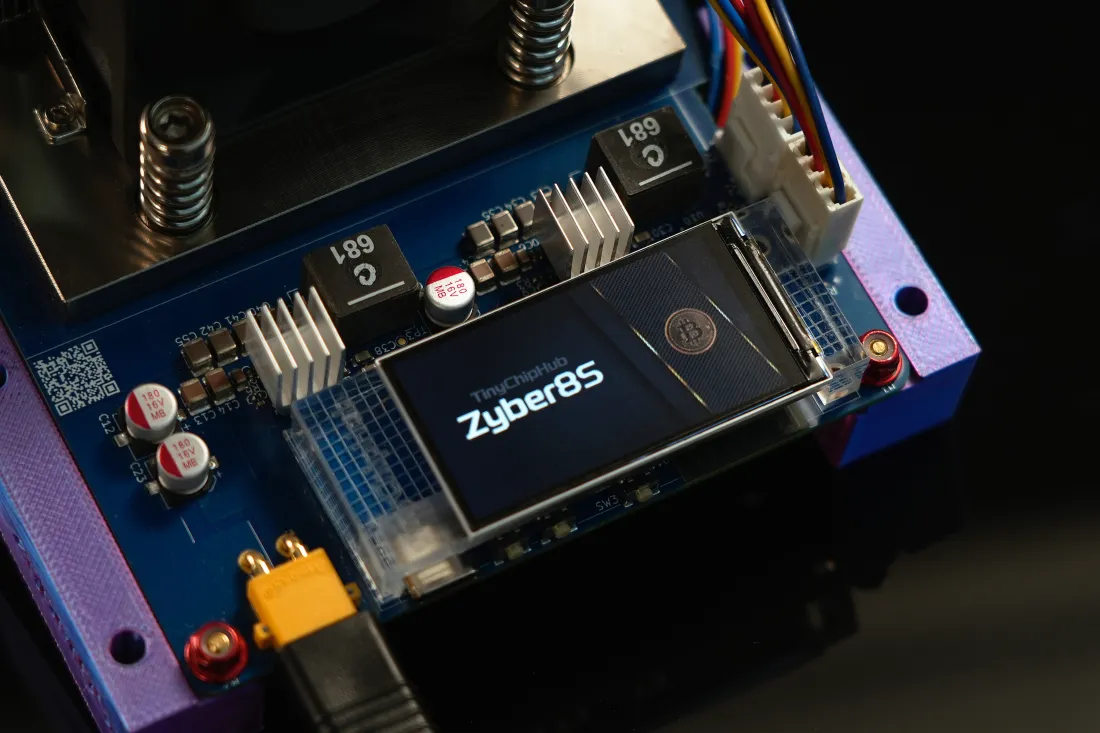
Bitcoin fell below the $60,000 mark, directly reaching $55,000. Is it time to panic? On the contrary, it is the time to re-examine the value of "lottery-style" home mining. When the market panics, ASIC miner manufacturers like TinyChipHub, with low barriers to entry and professional warranties, instead highlight the control fun and technical experimental value of digital Lego.
The South Korean Bitcoin blunder led to a sudden, massive, and abnormal sell order that directly crashed the buy-side market on the Bithumb exchange. As a result, it caused locally an extreme market where prices instantly plummeted to $55,000 (far below the global average of about $67,000 at the time). Therefore, the further plunge in the Binance market is indirectly related to the fat-finger event, but in reality, it is more influenced by the trend.
Treasure Chest Event 💰
The so-called "random treasure chest event" is essentially a promotional activity designed by Bithumb, South Korea's second-largest cryptocurrency exchange, to enhance user engagement! And it was this small promotional event that triggered a major blunder since the Bitcoin surge in the crypto circle!
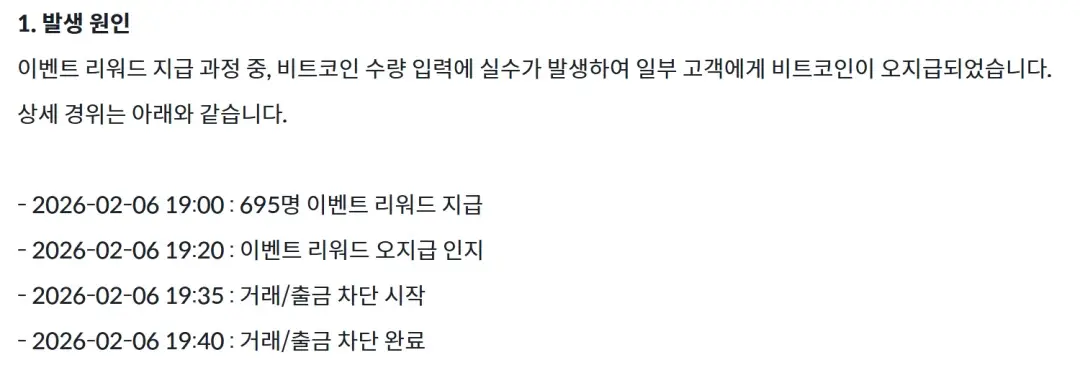
This random treasure chest event was originally scheduled to start at 19:00 local time on Friday (February 6) in South Korea, and Bithumb intended to pay each participant a winning amount of 2,000 to 50,000 Korean won! Moreover, Bithumb disclosed that 695 people participated in the event using points, and among them, 249 people who opened the chest were supposed to receive 620,000 won according to the original plan.

The core turning point was an operational error during the reward distribution process, where the unit was mistakenly entered as Bitcoin, accidentally distributing a total of 620,000 Bitcoins to users, effectively airdropping 620,000 Bitcoins (accounting for about 3% of the global Bitcoin total supply), averaging 2,490 per person. Based on the pre-incident Bitcoin price of 98 million won $67,000, this is equivalent to $41.5 billion/287.9 billion Chinese yuan, averaging $160 million/11.56 million yuan per person.
According to Bithumb's quarterly report, the Bitcoin airdropped by the exchange far exceeded its actual holdings. As of the end of last year's third quarter, the total number of Bitcoins held by Bithumb was only 42,600, which also sparked the "ghost Bitcoin" controversy. Therefore, this event has been referred to by multiple media as the "ghost" Bitcoin event.
The entire process is filled with unknown excitement, like waiting for a small technical meteor shower. You just participate in a small points treasure chest activity but encounter such a special event, making one sigh that the world is no less than a giant makeshift stage.
🤯 Crypto Market Blunder!
Mainstream media portray the market volatility as a "disaster," calling it the ghost Bitcoin event. Within 35 minutes after the incident, Bithumb froze the affected accounts and recovered 99.7% of the assets, but this event changed the perspective of Seoul regulators on the industry. Bithumb stated that it started suspending transactions and withdrawals for these credited accounts at 19:35 in the evening and completely blocked related operations at 19:40. According to exchange data, on Friday (February 6) evening, the Bitcoin price on the Bithumb platform briefly fell by 17% from about 98.29 million won (approximately $67,188) to 81.1 million won (approximately $55,400).
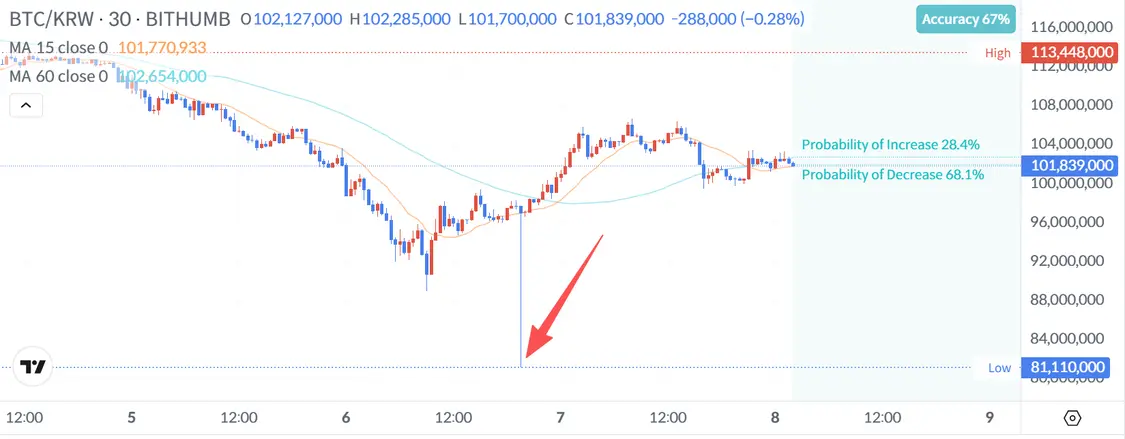
Unfortunately, this event also occurred during the recent continuous decline of Bitcoin, and on Friday evening,It hit a temporary low of $60,000. Many traders may mistakenly realize that the cause of the plunge is the "treasure chest bonus unit error," thus being drawn into panic selling. But in reality, this is more directly related to the three structural factors mentioned in subsequent articles!
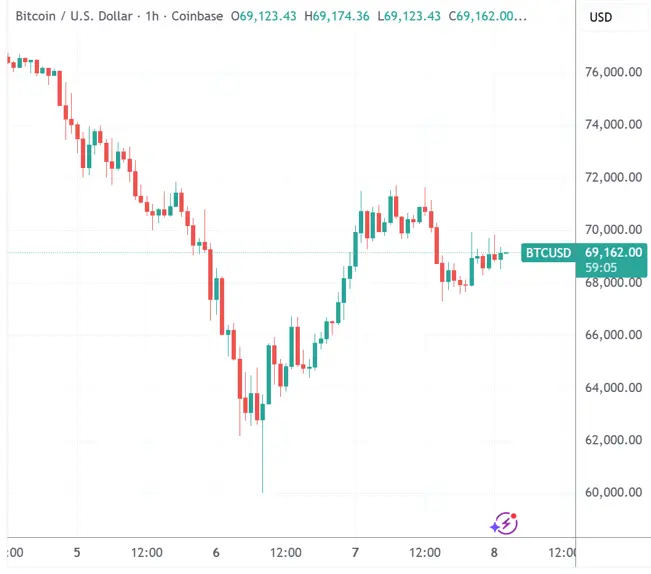
The following announcement shows that Bithumb confirmed that as of Saturday (February 7) at 16:00, the estimated loss for exchange users due to "panic selling" is about 1 billion won, and announced full compensation for the price difference for customers who sold at low prices between 19:30 and 19:45 on Friday evening, plus an additional 10% compensation. According to the latest disclosure from the exchange, out of the mistakenly issued 620,000 Bitcoins, 618,212 have been recovered. Shortly after the incident, assets equivalent to 1,788 Bitcoins were sold, and the exchange has recovered 93% of them. Assets equivalent to 125 Bitcoins remain unrecovered, calculated at the latest price of $69,000, equivalent to $8.625 million.
Lee Chan-jin, president of the Financial Supervisory Service (FSS) of South Korea, directly stated at a recent press conference that the event exposed "deep-seated vulnerabilities," damaging the credibility of cryptocurrency platforms. He pointed out: "This case exposes structural issues in the virtual asset electronic system. If cryptocurrencies are to be considered legitimate financial assets, solving the 'ghost coin' problem is crucial." FSS has sent an inspection team to Bithumb to investigate why basic security checks were lacking, especially why such large transactions did not require multi-layer approval.South Korea implemented the Virtual Asset User Protection Act in July 2024. But after the Bithumb incident, South Korea is drafting a new round of laws, expected to be completed in the first half of 2026.
Market Volatility Analysis 📊
The timing of Bithumb's mistake is particularly difficult for the entire Bitcoin industry. Just weeks ago, the South Korean government stated in its 2026 economic growth strategy that it would support the development of financial institutions.
- Spot Bitcoin ETF: Plans to allow the launch of spot digital asset ETFs in 2026 are currently under close scrutiny. President Lee Hsien Loong emphasized that cryptocurrencies must first prove their stability to become part of the traditional financial system.
- Institutional Investment: In January this year, the ban on corporate investment in cryptocurrencies was lifted, allowing companies to invest up to 5% of their equity in digital assets. However, analysts warn that the Bithumb scandal may cause companies to delay these plans due to new risk concerns.
- "Bithumb Punishment": Bithumb established a 100 billion won ($68 million) customer protection fund to win back trust, but the damage to South Korea's "kimchi premium" market remains severe.
The Bithumb incident sends a clear warning to global regulators: security doesn't just mean preventing hackers; it requires strong operations. As South Korea tightens regulations, the world is closely watching whether the country can balance rapid innovation with the strict security standards of traditional finance.
This market volatility analysis is not about predicting prices but understanding the true logic behind Bitcoin's plunge. When Bitcoin prices fall, the growth slope of the entire network's hash rate slows down in the short term, but opportunities for home miners may arise. Data from the Cambridge Centre for Alternative Finance (CCAF) in 2023 shows that in quarters where prices fell by more than 20%, the hash rate share of large mining farms decreased by an average of 3%, while the share of home/small miners remained relatively stable.
Behind this are two completely different cost logics. Large mining farms are extremely sensitive to electricity costs and financing costs, belonging to "elastic hash rate." On the other hand, home miners, especially those using new chips with energy efficiency ratios below 30 J/TH, are more motivated by technical enthusiasm and network support, belonging to "sticky hash rate." For us, volatility analysis key is to look at the network hash rate distribution map and block interval time, not the K-line chart.
- Step 1: Look at hash rate distribution. Visit BTC.com pool data to observe if the hash rate share of the top ten mining pools changes drastically. If concentration decreases, it means network decentralization improves during volatility, which is a victory for solo miners.
- Step 2: Look at block intervals. Normally 10 minutes. If blocks frequently appear with >15 minutes or <8 minutes, it indicates network instability, where the stable contribution of your equipment is more valuable.
- Step 3: Look at mempool size. When transactions are congested, choosing a high transaction fee pool strategy may cause your Zyber 8G Premium to "idle," so you should manually switch to "energy-saving mode" or "only pack basic transactions" mode.
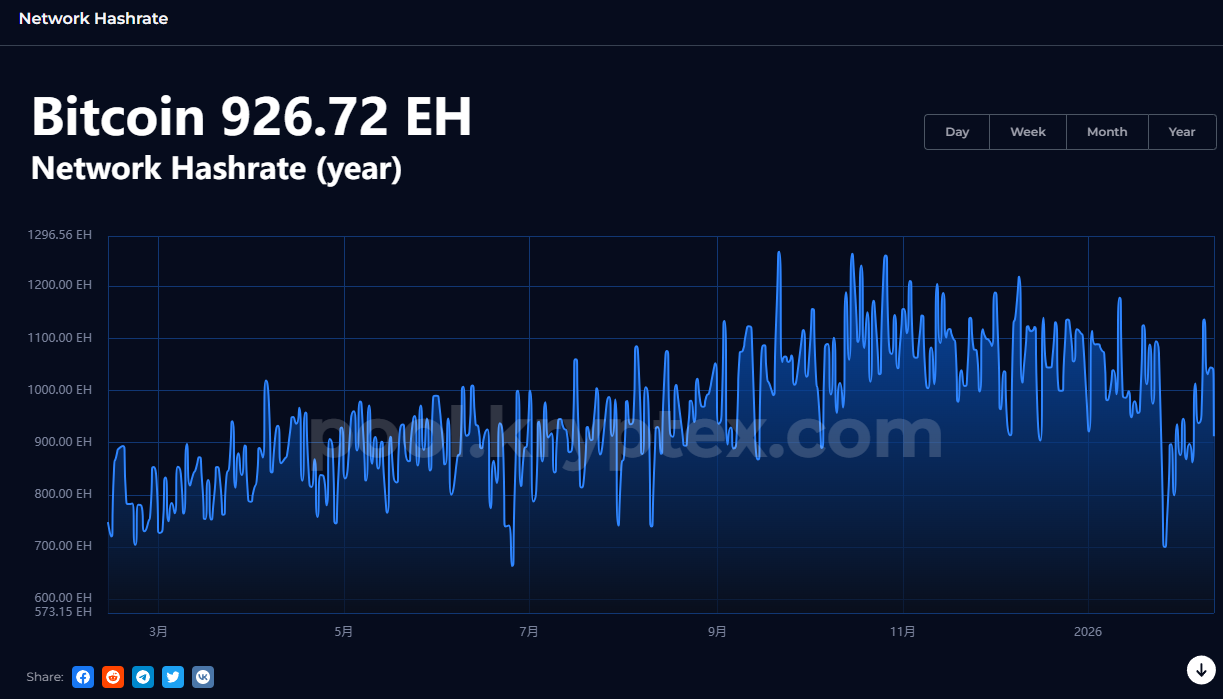
Remember, our analysis dashboard is the blockchain explorer, try to avoid financial apps. Focus on on-chain fundamentals to escape the "ghost hitting the wall" of market sentiment. According to Kryptex Pool data from February 2026, the entire network's hash rate maintains resilient growth of about 926.72 EH/s during major price fluctuations, indicating that the home hash rate node network is quietly recovering.
🚀 Risks? Assessment
It's hard to ignore financial risks, but in the real risk list of home mining, the first is always hardware failures like thermal management failure, but the second is definitely network security vulnerabilities. Many people get the order wrong, worrying all day about machine breakdown, but in fact, machines are more durable than you think; instead, the network, this "silent killer," is most likely to make you crash.
Thermal risks and other mechanical failures are physical aspects. When an air-cooled miner is running, the temperature difference control between the air intake and outlet is crucial. This requires strict air convection planning, even designing a separate "air duct" for the ASIC miner, rather than simply throwing it in a corner.
Network risks are digital aspects. Your miner is a 7x24 online IoT device. Weak passwords, outdated firmware, open ports are all invitations for hackers to "visit." You must:
- Enable two-factor authentication (2FA) for the management backend.
- Regularly update firmware to patch security vulnerabilities.
- Use a virtual private network (VPN) or firewall rules to restrict miner access to the local network.
And this is just the minimum network risk; the bigger one is market panic caused by local crashes like the ghost Bitcoin event! True risk assessment isn't asking "will I lose money," but asking "can my equipment continue running under extreme high temperatures," "is my miner the weakest link when my home network is scanned for attacks," "can I keep going when I see Bitcoin plummet." After solving these technical issues, you still need to adjust your mindset, otherwise, you'll have trouble sleeping at night.