💡 Tip: The following article data is for reference only. Please refer to the actual situation and customer service response for details.
How does a well-designed Bitcoin solo miner achieve silent operation? The core lies in using low-power BM1370 dedicated ASIC chips. These chips significantly increase computing power while drastically reducing energy consumption, thereby lowering cooling demands. This allows the device to operate stably relying on silent passive heat sinks or low-speed fans.
For example, the Bitaxe Gamma Turbo has a rated hash rate of 2.4+ TH/s with a power consumption of only 42W, and operating noise as low as 34 dBA. In contrast, industrial-grade ASIC miners typically rely on high-speed fans for cooling, with noise often exceeding 60 decibels. Therefore, these crypto mining devices designed for the geek community emphasize a quiet home environment while ensuring efficiency, achieving a perfect balance between high performance and low noise!
⚡ Low Power Consumption
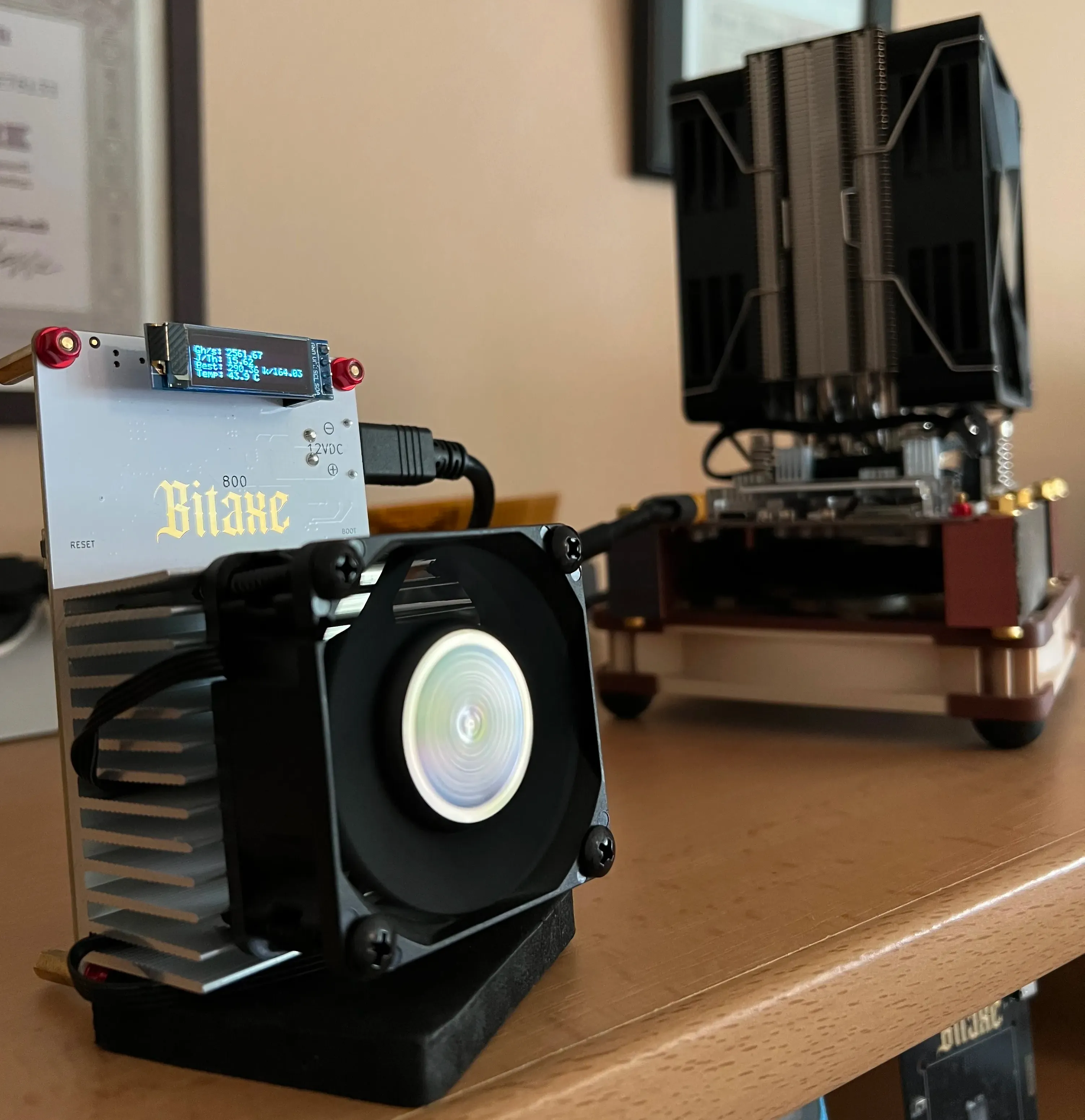
The secret to silent mining first lies in power consumption! For a well-designed Bitcoin solo miner, such as the Bitaxe GT 800 launched by TinyChipHub, the starting point for silence is "low power means low heat, low heat means low noise." This thing can have its idle power consumption pressed to 42 watts or below. Noise is essentially a byproduct of wasted energy; with lower power consumption, heat generation decreases, so the fan doesn't need to work at full blast.
Why is power consumption so critical?
First, you need to understand the source of miner noise =》 the fan. The fan spins wildly to dissipate the massive heat generated by the chip. Where does the heat come from? From electrical energy conversion. According to Joule's law, electrical energy is almost directly converted proportionally into thermal energy. Therefore, halving the power consumption theoretically halves the heat generation, allowing the fan speed to switch from "jet engine" mode to "library ventilation" mode.
- Chip-Level Optimization: The firmware communicates directly with the BM1370 chip to achieve extreme improvement in energy efficiency ratio (J/TH). According to the 2025 Axe OS+ test report, optimized firmware can improve the energy efficiency of the same hardware by up to 5%.
- Power Supply Overclocking Standard: Using a Mean Well power supply for overclocking means utilizing massive electrical energy to achieve ultimate performance! Perhaps part of the power should be reduced to achieve the most cost-effective result.
- Dynamic Frequency Adjustment: Advanced firmware allows you to dynamically adjust chip frequency and voltage based on ambient temperature, always operating at the intersection of quietness and efficiency for 7x24 stable operation.
According to the miner noise white paper released by Bitmain in 2024, the main reason traditional air-cooled miners exceed 60 decibels is to cope with the heat generated by power consumption exceeding 200 watts. Keeping the whole machine's power consumption under 100 watts is a physical prerequisite for achieving a silent environment below 45 decibels (equivalent to a quiet indoor conversation). Therefore, the first step in pursuing silence is to relentlessly focus on power consumption, which directly determines whether you are "home mining" or "running a factory."
🔥 Key Tip: Don't just look at the manufacturer's advertised "maximum hash rate"; keep an eye on the "Power per Terahash (J/TH)" data, commonly known as energy efficiency ratio. A machine optimized from 25 J/TH to 19 J/TH is the start of you getting a good night's sleep.
Efficient Cooling Solutions ❄️
With lower power consumption, the cooling system can shift from "brute force suppression" to "fine-tuned control." Silent miner cooling relies on clever techniques, not brute force. The idea is simple: use the maximum airflow to remove the most heat while keeping the fan speed below the noise threshold.
| Cooling Solution | Typical Noise (dB) | Core Techniques | Applicable Scenarios |
|---|---|---|---|
| High-Speed Violent Fan | >60 | Direct high-pressure airflow | Industrial mining farms |
| Optimized Cooling Fan | 35-45 | Can provide 27.4 CFM at maximum speed of 5000 RPM | Home office |
| Passive Cooling | <35 | Ultra-large fin area, thermal paste, airflow design, PCB material... | Very low-power devices or winter |
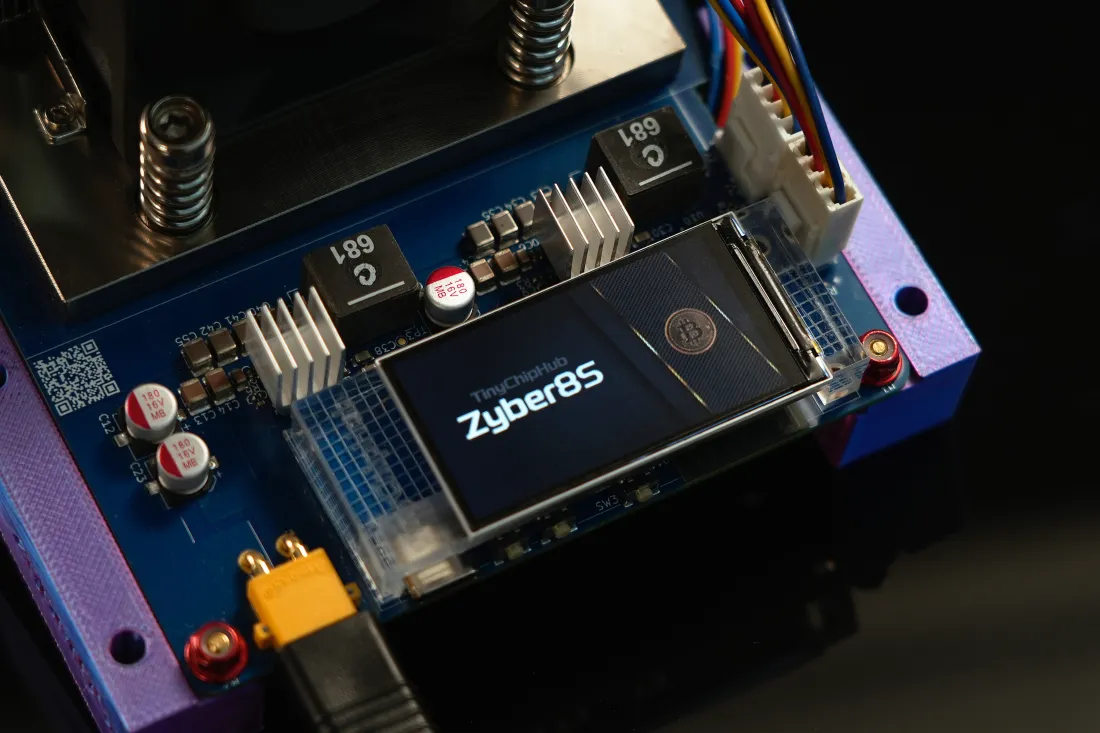
The intricacies here are more complex than just adding a couple of fans to a computer case. First, it requires a luxurious setup of heat pipes + large-area fin arrays. Heat pipes are responsible for quickly conducting chip hotspots to the entire cooling module, while fins maximize heat exchange area. For example, some modification solutions equip miner chips with a 6-heatpipe dual-tower cooler originally designed for high-end CPUs! If that doesn't ring a bell, you can refer to the fan on the Zyber 8G Premium launched by TinyChipHub.
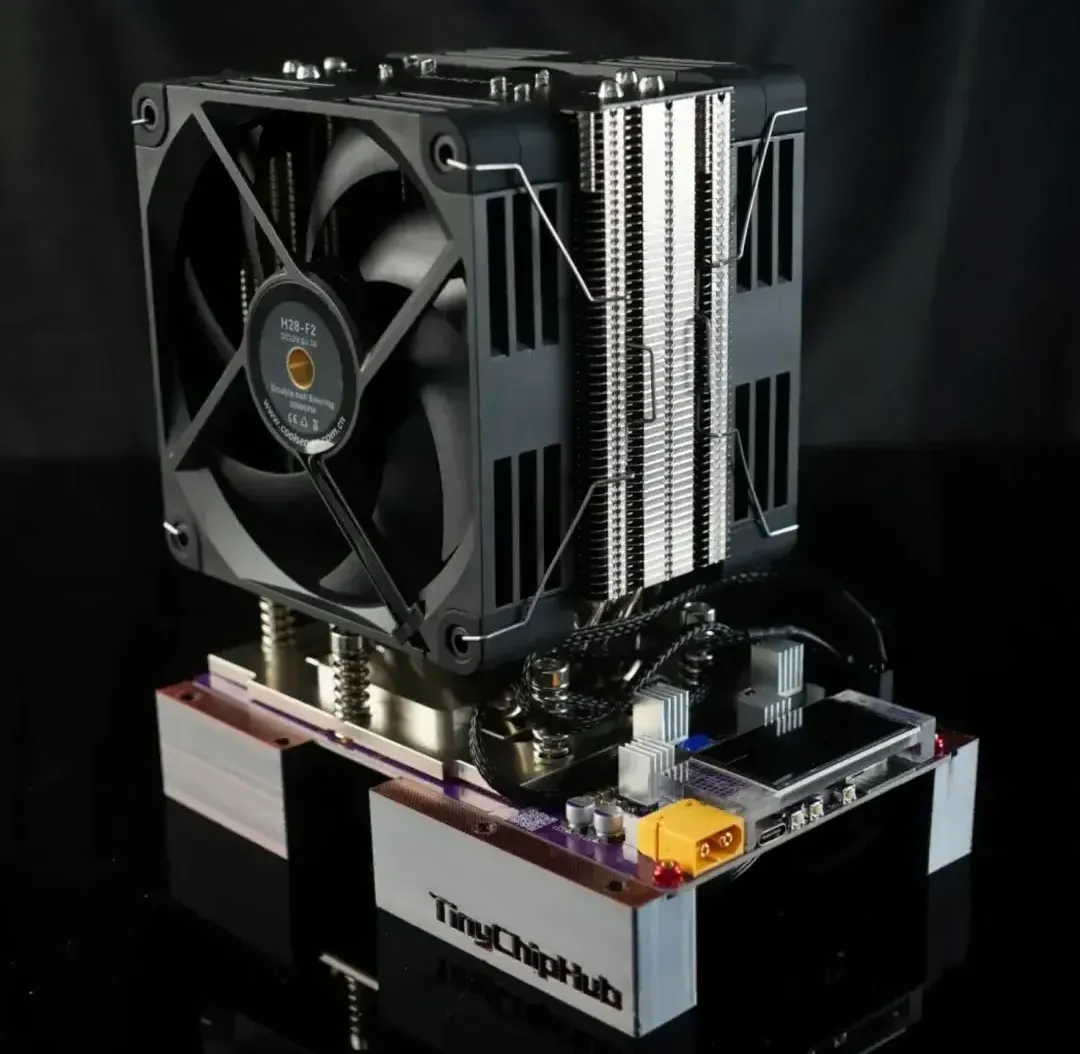
Second, airflow design is the soul. A good case allows air to flow like a well-planned convoy, entering orderly, passing over all heating components, and then leaving with the heat. Straight-through front-to-back airflow and avoiding turbulence are key. From my own tinkering experience, when adding dust filters to intake vents, be sure they have sufficient ventilation area, so the dust filter doesn't become a bottleneck for noise and airflow.
The American Society of Heating, Refrigerating and Air-Conditioning Engineers (ASHRAE) emphasized in its 2024 data center cooling guidelines that "targeted airflow management" is more effective than simply increasing fan speed. For small miners, this means you need to conduct a smoke test on the airflow to ensure no hot air short-circuiting (exhausted hot air being sucked back in). A simple trick: placing a small auxiliary fan a few centimeters behind the miner (at the exhaust) to assist with exhaust can significantly lower core temperatures, allowing the main fan speed to drop another notch.
⚠️ Risk Warning: Blindly pursuing absolute silence (such as pure passive cooling) may cause chip overheating and throttling, reducing hash rate. You must set safety thresholds in the temperature monitoring backend (e.g., automatically increasing fan speed when chip temperature >70°C).
💻 Specialized Hardware & Firmware
Hardware is the body, but firmware is the brain that makes the miner "quietly intelligent." Silence is not about sacrificing performance but achieving it through hardware-software synergy, making the machine do the right thing at the right time. In terms of hardware, besides the low-power chips and efficient cooling modules mentioned earlier, the quality of the fan itself is crucial. It is recommended to use fans with FDB (Fluid Dynamic Bearing) or magnetic levitation bearings. These fans are not only quieter at low speeds but also have a much longer lifespan than ordinary sleeve bearing fans.
- Silence at the Firmware Level: Flashing third-party firmware like Axe OS+ unlocks powerful temperature-fan curve customization. You can set the fan speed to maintain a minimum of 80% when the chip temperature is below 60°C, even if it means a slight loss in hash rate.
- Intelligent Task Scheduling: The firmware can set mining schedules. For example, automatically switch to "silent mode" (reduced frequency and power) from 10 PM to 7 AM when family is resting, and run at full speed during the day. This is fully automated, requiring no manual intervention.
- Monitoring and Alerts: Silence doesn't mean neglect. Good firmware provides detailed monitoring. If abnormal temperatures are detected (e.g., due to dust clogging reducing cooling efficiency), it will send alerts via mobile app logs, allowing you to take timely action to avoid hardware damage.
According to a report at the 2025 Prague Bitcoin Miners Conference, miners using their smart firmware saw an average 40% reduction in fan operating speed, corresponding to a noise reduction of about 15 decibels, with a hash rate loss of only around 3%. This trade-off of minimal performance loss for a significant improvement in quality of life is arguably the most cost-effective method for home miners. Don't forget, when your miner passes FCC/CE certification, its radio frequency compatibility testing also indirectly ensures the stability of the control circuit and fan motor operation in complex electromagnetic environments, which is also the foundation for quiet operation.
Customization ⚙️
Ultimate silence belongs to those "geeks" willing to get their hands dirty. Standardized miners are assembly-line products, but your usage environment is unique. Customization is about perfectly adapting the machine to your "mine" (which might be a corner of the study or a closet). Environmental integration is the first lesson. Putting a home miner into a well-ventilated soundproof cabinet or a sealed space with active exhaust ducts (like a modified storage box) can physically isolate most of the noise. The key is to calculate the area of the intake and exhaust vents and manage dust prevention.
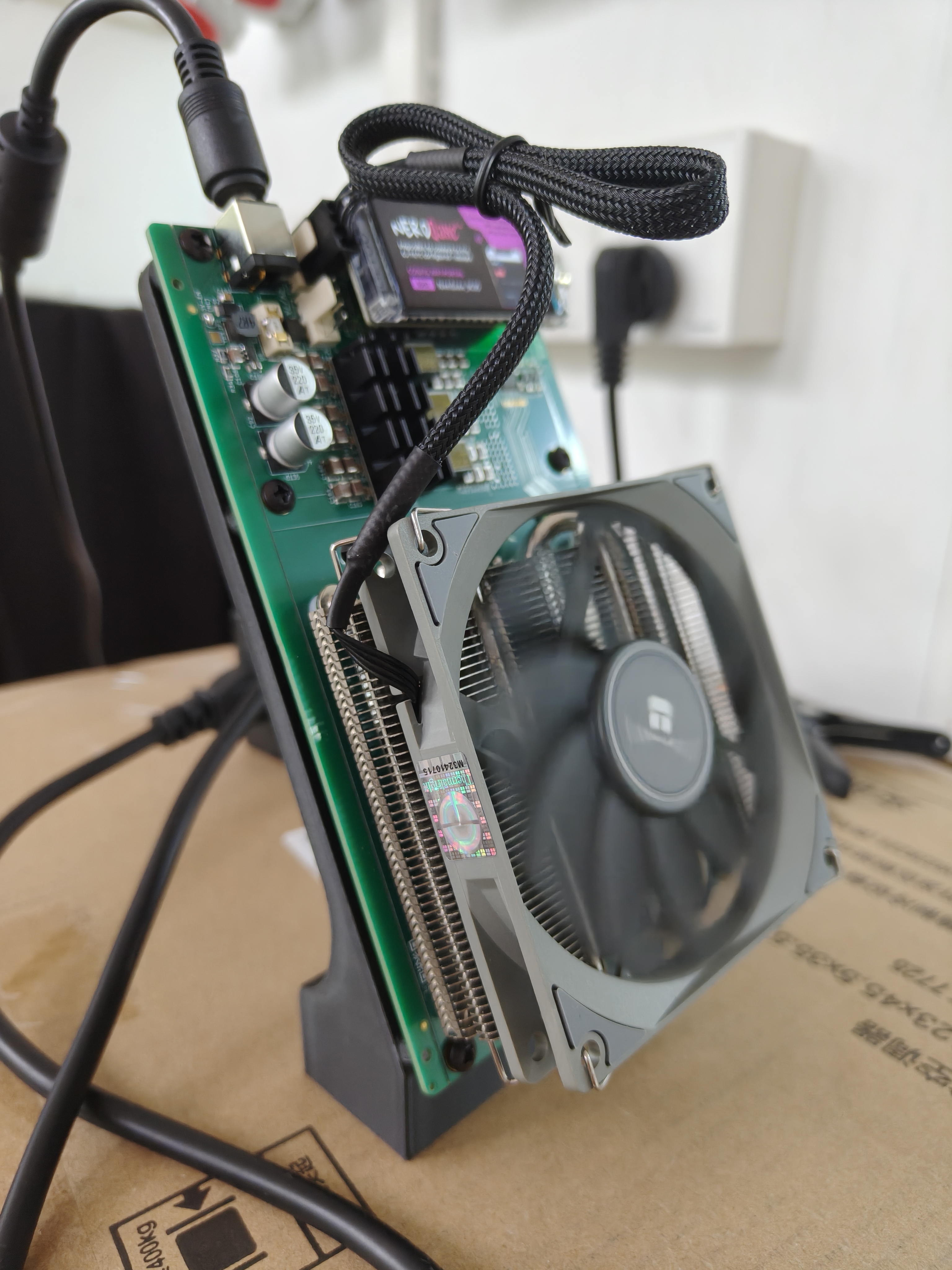
This process is like tuning a car; the fun lies in control. What you get is not just a silent machine but a digital companion that operates entirely according to your will. When it runs quietly in the corner, with only indicator lights blinking regularly, that feeling of "having everything under control" is far more addictive than hearing the roar of fans. 🚀
- Vibration-Damping Base: Installing vibration-damping pads on the miner base and at the four corners of the fan can effectively eliminate the low-frequency hum caused by resonance.
- Custom Cables: Using soft silicone-sheathed wires or cables of just the right length avoids messy cables blocking airflow, which would force the fan to spin faster.
- Software Overclocking/Underclocking: This is the essence of customization. Through repeated testing, find the optimal silent balance point for your chip in the voltage-frequency-temperature triangle. Each chip's constitution is different; only you can find this point through experimentation.
When you complete all the adjustments and press the start button, hearing only the slight sound of the hard drive reading, not the roar of the fan, that sense of achievement is much more thrilling than simply seeing your wallet grow. This thing, placed at home, is no longer a noisy money-making machine but a piece of art that showcases your technical prowess and silently computes.
The process is actually full of fun. You can also play detective, using a decibel meter to identify the miner's main noise source (usually the fan), and then address it accordingly. According to Reddit forum experiences, a successful deep modification can reduce overall machine noise by another 5-8 decibels and improve power efficiency by 3-5%. Remember, the core of modification is balance; don't fry the machine in pursuit of ultimate silence. You clearly know where every bit of energy is used and how every bit of heat is expelled.
Ultimate silence will belong to those geeks willing to do it themselves. This isn't simple plug-and-play; it's about turning your Bitcoin Solo Miner into a unique partner that fits your life rhythm!