.jpeg?w=4000&h=2667)
1. Understanding Power Basics: Watts vs. Kilowatt-Hours
When evaluating home mining operations, two fundamental units dominate the conversation: watts (W) and kilowatt-hours (kWh).
- A watt (W) measures instantaneous power consumption – think of it as the "speed" at which your device uses electricity. To calculate a device's power consumption, the formula is:
Power (W)= Voltage (V) × Current (A)
A device rated 12V/5A on its label means that it consumes 60W per hour. For most mining devices, the power consumption varies due to several factors. However, we can still simply calculate its power consumption using the instant voltage and current values shown on the display.
- The kilowatt-hour(1,000 watts used for one hour) represents the actual energy consumed over time. This metric is crucial because utility companies worldwide bill customers based on kWh usage. A typical industrial ASIC miner consuming over 2,000W running continuously for 24 hours would use 48 kWh daily. At German residential rates averaging €0.35/kWh, that's €16.8 per day – over €6,000 annually. Understanding this distinction helps miners accurately forecast operational costs.
*Calculation: 2000W/1000=2kW; 2 kW*24 hours= 48 kWh; 48 kWh* 365 days *€0.35 =€6132
2. The True Cost of Mining: Beyond Voltage and Current
While the basic power formula (Power = Voltage × Current) provides a starting point, real-world mining rigs exhibit more complex energy dynamics. Consider a device rated at 12V/5A (60W theoretical draw). When measured with a power meter, actual consumption often reaches 72-84W. This discrepancy doesn't indicate manufacturer deception. These factors explain why measured consumption often exceeds manufacturer specifications by 10-30%:
- Power Supply Inefficiency: The power from your wall socket is AC (Alternating Current), which is suitable for long-distance transmission through the electrical grid while minimizing energy losses. However, this type of power cannot be used directly by most devices. It requires an AC/DC converter to step down the voltage to a usable level and convert it to DC (Direct Current) to avoid damaging your equipment.
During this conversion process, inevitable energy losses occur. Most AC/DC converters operate at 80-90% efficiency. For example, a 90% - efficient PSU converting 67W of grid power would deliver approximately 60W to your device (67W × 0.9 ≈ 60W), with about 7W lost as waste heat.
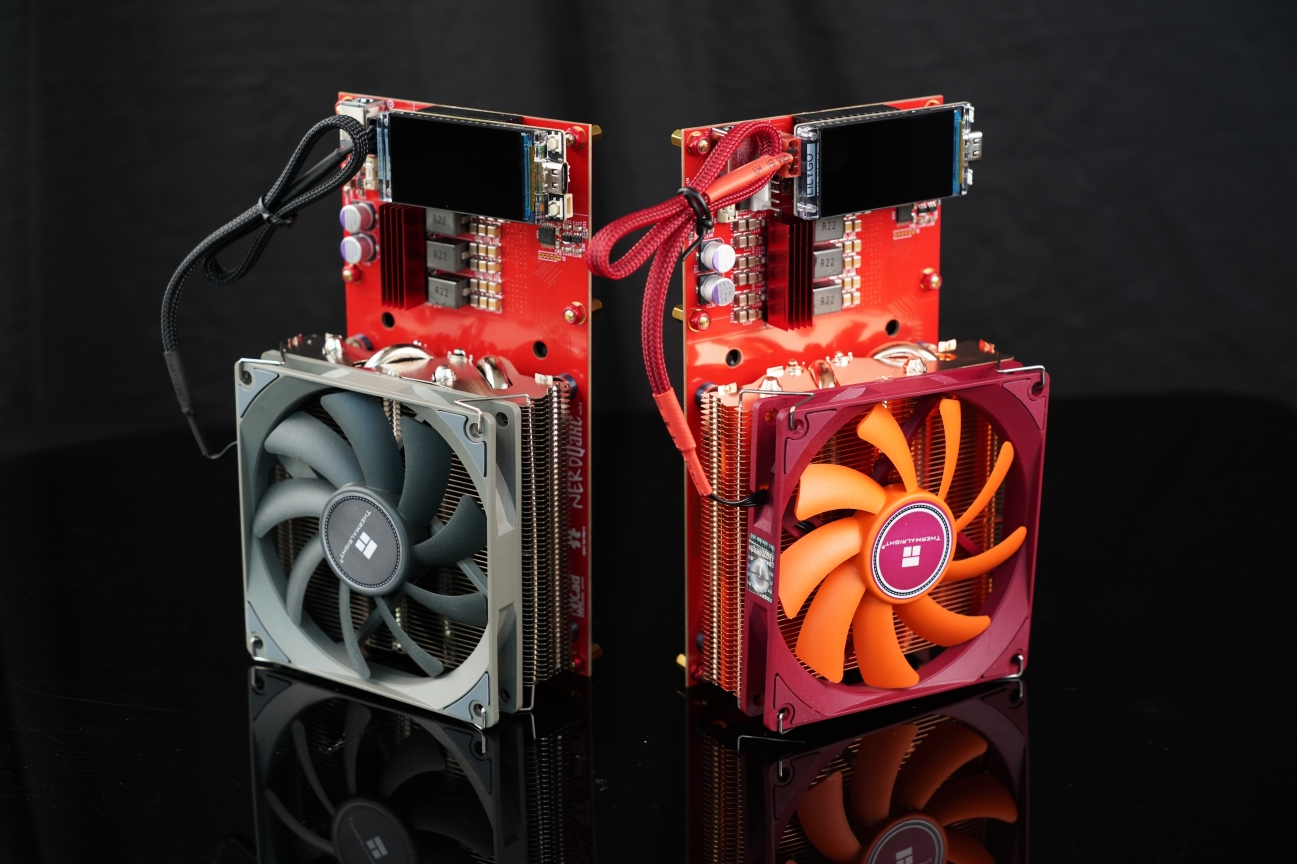
- Thermal Management Overhead: Cooling systems typically add an extra 5-10% energy load. A mining rig with a single 120mm fan might consume an additional 6W. However, this is a balancing act: while fans increase power draw, excessively hot components can raise energy consumption by 10-20% due to thermal resistance and waste heat. For long-term reliability, it's preferable to slightly overdrive cooling fans rather than risk component degradation from overheating.
During this conversion process, inevitable energy losses occur. Most AC/DC converters operate at 80-90% efficiency. For example, a 90% - efficient PSU converting 67W of grid power would deliver approximately 60W to your device (67W × 0.9 ≈ 60W), with about 7W lost as waste heat.
- Standby Power Drain: Despite the always-on screen consumes additional power, even "off" devices consume standby power (often called "phantom load"). An AC/DC adapter plugged into a wall socket but not connected to any device will still draw minor power of 5W. This principle applies to any electronic equipment! To maximize energy savings, remember to disconnect unused devices or adapters from sockets!
3. Selecting the Perfect Power Adapter: Volts, Amps, and Safety Margins
Choosing an appropriate power supply unit (PSU) requires careful calculation and examination:
- Voltage Compatibility: Verify that the PSU supports 110-240V AC input to ensure compatibility with your region's power grid.
- Output Compatibility: It's CRUCIAL to confirm that the output voltage never exceeds your device's maximum rating before plugging it in. Using a lower-voltage supply may reduce efficiency (e.g., operating at half hashrate), but plugging in a higher-voltage supply will fry your device immediately (e.g., connecting a 12V PSU like the Bitaxe Hex's to a 5V device like the Bitaxe Gamma. The moment you plug it in, you will soon detect a smell of money vanishing). Such tragedies occur frequently if you have multiple devices at home and doesn't play attention on the electrical specifications!
- Current Capacity: Calculate the total device current draw (amps) and add a 20% buffer is suitable for most situations. For a 12V/5A device consuming 60W, it is better to select a 12V/6A PSU that provides at least 72W output. Over-specifying your PSU yields significant benefits! A higher-capacity PSU operates cooler, lasts longer, and maintains higher efficiency under load spikes.
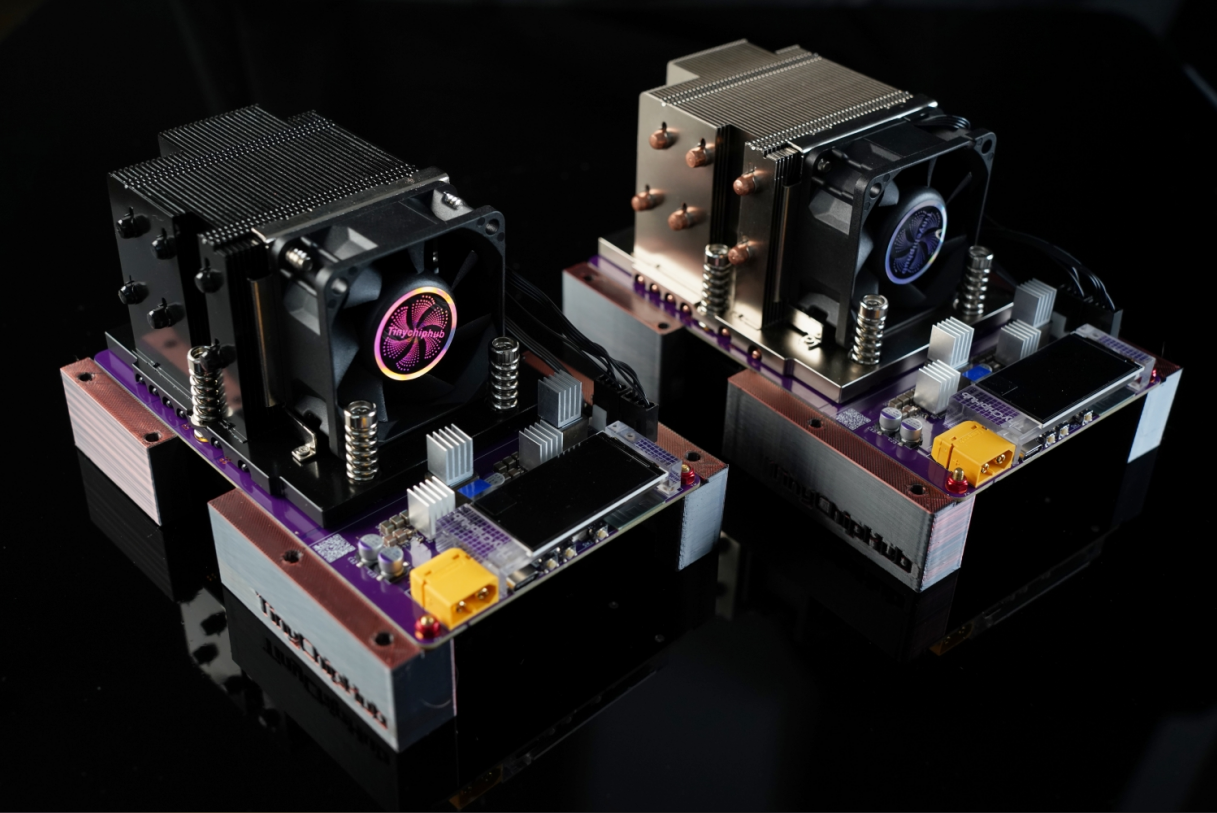
However, this creats another balancing act: the higher the amps the PSU provides, the more expensive it will be. Additionally, verify if your device can handle such high current (e.g., PCB copper thickness). Even with a PSU that has a large capacity, overclocking your device beyond its circuit endurance limits will generate excessive heat! Most general manufacturers use less than 1oz copper for cost savings (but we can assure you that all multi-chip models at TinyChipHub utilize 2oz copper)!
- Certification Matters: Specifications on the label sometimes can be just an improvisation of manufacturer. Look for those with safety certifications (CE, FCC, UL) or from the manufacturer that is reliable!
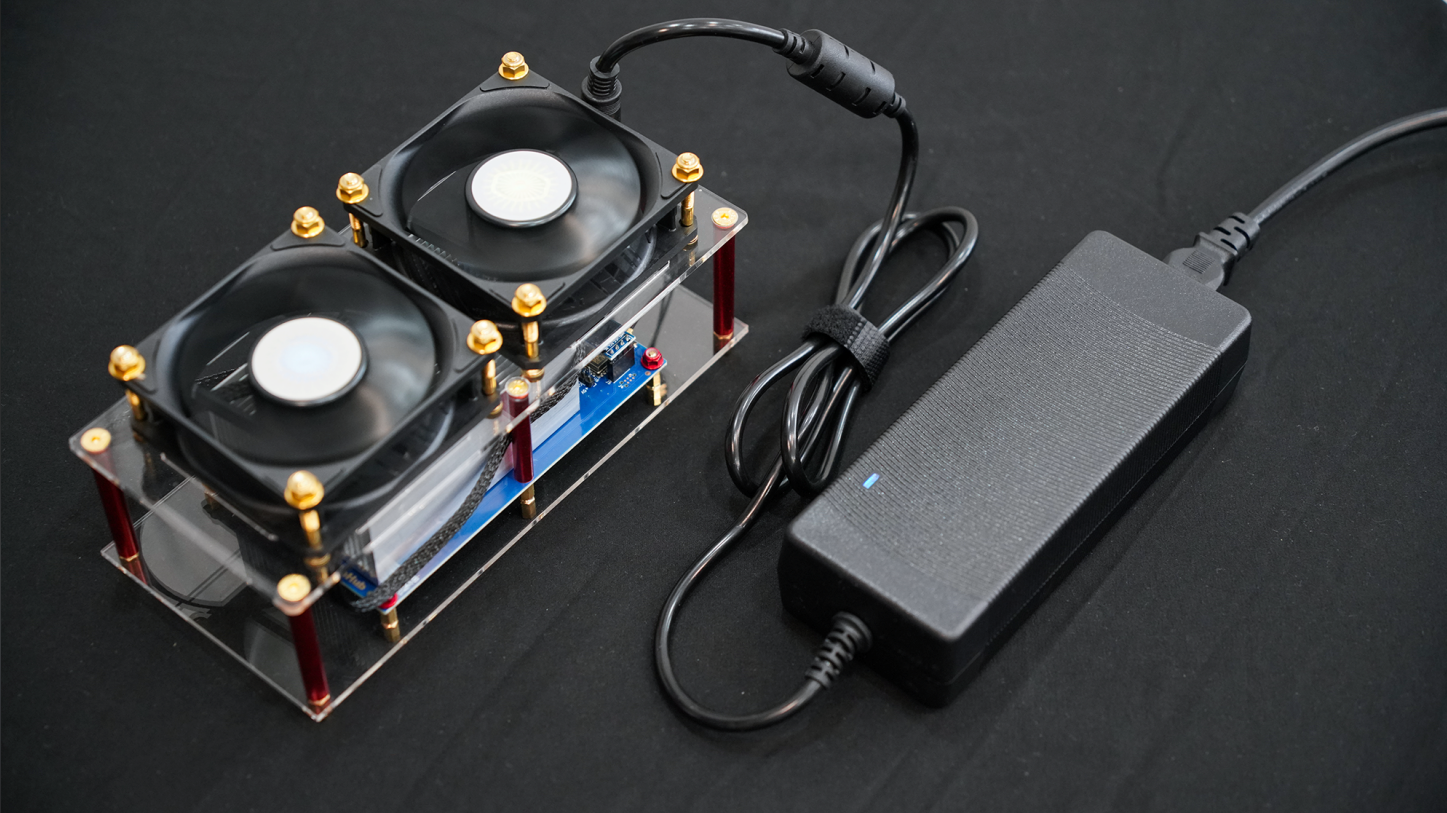
Choosing a suitable PSU may not be an easy task. Here, we offer Laboratory-Optimized Power Supplies/Adapters for Home Miners, which have undergone testing with hundreds of our units to ensure their quality. We provide various choices for different models of home miners. If you are unsure which one fits your device, kindly contact us for assistance!
4. Practical Energy Optimization Strategies
- Optimized Heat Management: Since excessive heat significantly increases energy consumption (particularly when ASIC temperatures exceed 70°C), take these measures:
1. Choose a miner with open-air (non-enclosed) frame design to prevent heat accumulation.
2. Inquire about the copper layer thickness (most manufacturers may not disclose this specification), thicker copper enhances thermal conductivity and improves heat dissipation efficiency.
3. Set cooling fans to higher speed to reduce operational temperatures or consider adding supplementary fans for enhanced airflow.
4. Relocate the miner to a cooler environment. Maintain ≥30cm clearance from walls for proper ventilation.
5. Avoid placing power supply units (PSUs) near miners as both generate heat. Side place the PSU to create additional space for heat dissipation.
- Balancing Hash Rate and Energy Costs: The relationship between mining performance and power consumption follows a non-linear curve. Core voltage (Vcore) and clock frequency (MHz) interact exponentially, as demonstrated by the formula (parameters vary by device, shown for illustrative purposes):
Last word
Home mining profitability hinges on energy mastery. Whether you choose ultra-efficient ASICs or a good behavior, small optimizations compound into major returns.
Ready to slash your mining costs? We have thoroughly applied engineering science principles to our product design, achieving comprehensive optimization in areas including efficiency and thermal management. Explore our optimized Home Miners Collection —your next kilowatt-hour saved starts here!