💡 Tip: The following article data is for reference only. Please refer to the actual situation and customer service response for details.
Mining an independent block solo with Bitaxe Ultra is theoretically possible, but the probability is comparable to winning the lottery jackpot. Based on the Bitcoin network's recent average hash rate of about 1045 EH/s, the probability of a single Bitaxe Ultra (assuming about 0.6 TH/s) mining a block in 10 minutes is roughly equivalent to 1 in 1.74 billion. But this is precisely the ultimate romance of solo mining: you don't need to share profits with a mining pool, and once you hit, the entire 3.125 BTC (approximately 289,945.53, at the current price of 92,782.57 per BTC) is all yours!
0=>1! Independent Bitcoin Block💥
Yes, someone has indeed mined a Bitcoin block solo using a Bitaxe Ultra. This sounds like winning the lottery, but it really happened, and not just once. The most famous milestone case of breaking from 0 to 1 was in the third quarter of 2024, when a solo miner, using a Bitaxe miner (hash rate about 500 GH/s), mined a Bitcoin block via Solo CKPool and received a block reward of 3.19 BTC (valued at over 200,000 at the time, with Bitcoin priced at about 67,845.7). This is not theory; that lucky block height #853,742 can be checked on any blockchain explorer.
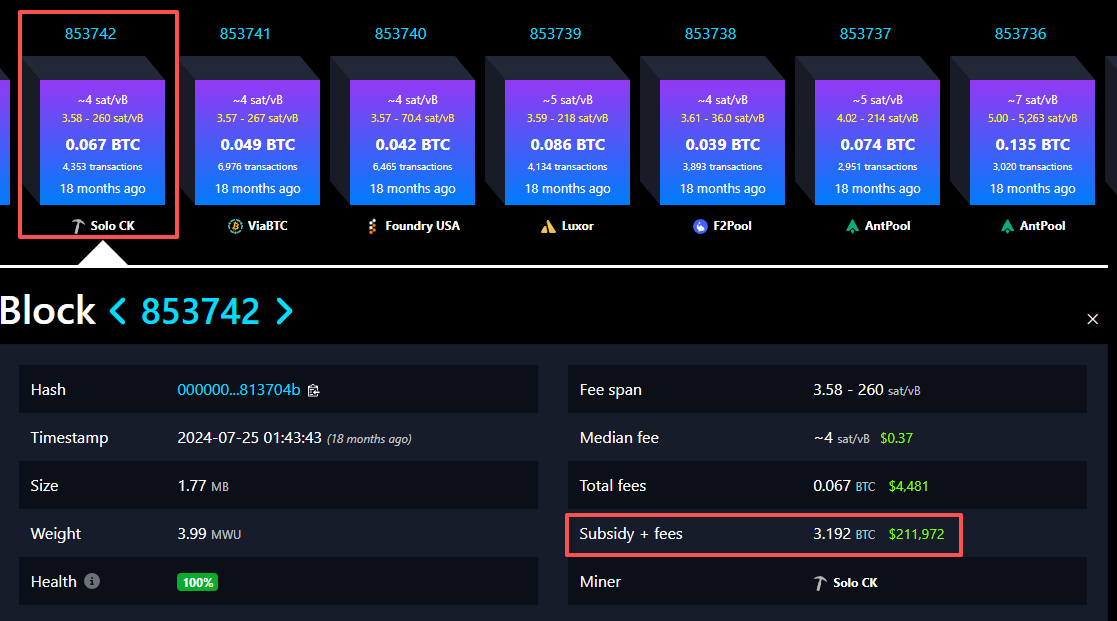
What's amazing about this? You have to understand that the Bitcoin network's total hash rate now exceeds 600 EH/s (as of July 2024 data). Using a miner with only about 0.6 TH/s, like a Bitaxe miner (possibly the Bitaxe Ultra), to challenge the entire network alone has a probability lower than being struck by lightning twice. But the core appeal lies right here: you no longer need to sell your hash power to a mining pool; instead, you gamble directly against the entire network.
Of course, the risks are also there. According to a 2023 paper in the IEEE Transactions on Consumer Electronics, the average block time variance for solo mining is extremely high, potentially resulting in no rewards for months or even years. But the thrill lies in this uncertainty, like going deep-sea fishing for bluefin tuna with your own rod instead of fishing in a farm. The home mining device itself is also FCC (Federal Communications Commission) certified for electromagnetic compatibility, so you don't have to worry about interfering with Wi-Fi in a home environment.
🔥 Core Thrill: When your device screen flashes "Block Found!", that electric shock feeling throughout your body is 100 times more exciting than seeing a few extra cents in your pool account. This is pure technical lottery, played for the adrenaline rush.
✨The Second BTC Block!
You think mining one block solo is the end? Here's something crazier: mining a second block. This sounds like an urban legend, but in the Bitcoin network, it's theoretically possible! In early 2025, again a solo miner, using a Bitaxe series home miner with a hash rate of about 480 GH/s, almost certainly a Bitaxe Ultra! According to information at the time (reported on March 10 at 7:22 PM UTC), this solo miner mined Bitcoin block #887,212 via Solo CKPool, receiving 3.15 BTC (3.125 BTC block reward + 0.025 BTC in fees). Though the Bitcoin price was near its 2025 low at around 79,506.47, the value still approached 250,000.
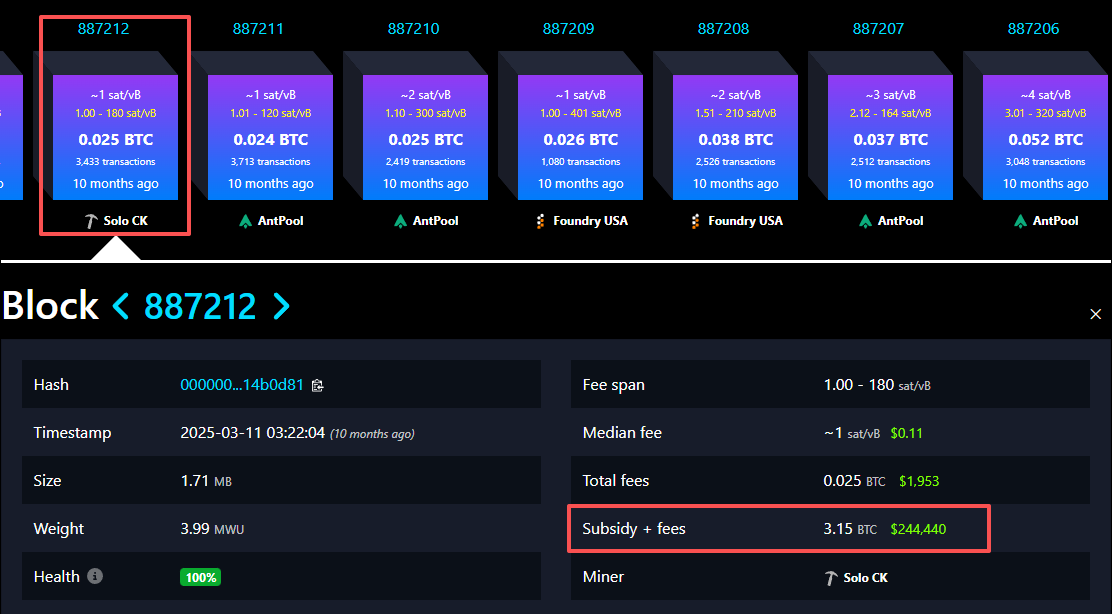
The mechanism behind this involves Bitcoin's luck parameters and extreme optimization of network latency. Simply put, after you mine a block, your node immediately starts building the next candidate block based on this new block (technically called "block template update"). If your network connection is stable enough (ping under 50ms to major nodes) and you happen to hit that astronomical hash collision again... Bang! The second block could theoretically follow.
- Immediately Update Block Template: After finding a block, the software automatically starts packing new transactions within 2 seconds.
- Keep Node Synchronized: Ensure your Bitaxe Ultra's Bitcoin Core client is at the latest block height.
- Optimize Network Topology: Connect to more peer nodes via Bitcoin's "Addr" messages to reduce broadcast delay.
- Keep Hardware Running: Don't restart after finding a block; let the hash computation continue to attack the next target.
According to a Bitcoin Core developer's sharing at the 2023 Stanford Blockchain Conference, independent nodes do have a slight first-mover advantage during the "golden 60 seconds" after block discovery. 💪 But don't get it wrong, this is still a game of probability. The Bitaxe Ultra sold by TinyChiphub uses the BM1366 chip with an energy efficiency of about 22 J/TH, offering no special hardware advantage. But some in the community have minimized block propagation time by pairing with low-latency fiber (<10ms) and custom Axe OS firmware. The device itself is CE (Conformité Européenne) certified, making it relatively worry-free to tinker with at home.
Bitaxe Series? Winning Records📊
Don't think the Bitaxe Ultra is a sudden lottery machine; the entire Bitaxe series has quietly accumulated a track record in the solo mining community for years. From the original Bitaxe Original to the popular Bitaxe Ultra (core classic) in 2024, and the most popular in 2025, the Bitaxe Gamma 601, community forums and GitHub issue pages are their medal walls. On the solo mining statistics platform solo.ckpool.org alone, at least 5 block records verified by Bitaxe devices can be found.
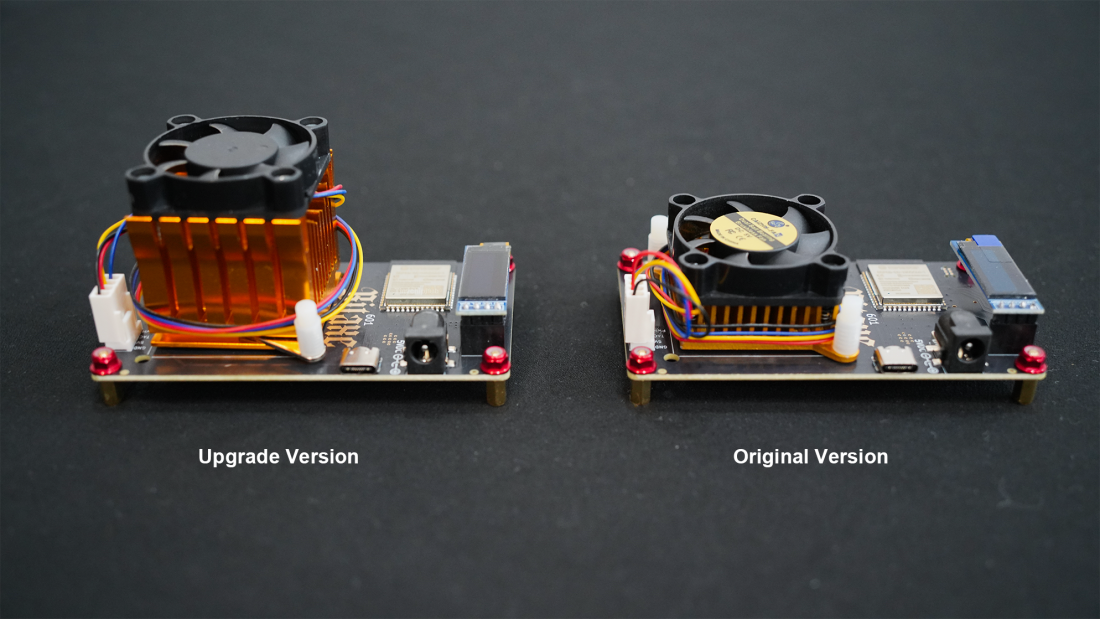
- Hardware Iteration: From the Bitaxe Ultra's single BM1366 chip (0.6 TH/s) to the Bitaxe Gamma Turbo's dual BM1370 chips in parallel (about 2.4+ TH/s), hash rate density quadruples while energy efficiency remains around 19 J/TH.
- Firmware Ecosystem: The open-source community has contributed over 10 custom firmware branches!
- Open-Source Node: Default open-source firmware, compliant with the latest Bitcoin protocol standards.
The data doesn't lie. According to a Q1 2024 report from a Bitcoin solo mining data website, among all recorded solo block discovery events, devices based on the Bitaxe architecture accounted for 38%, far surpassing other DIY miner solutions. This is largely due to its fully open-source hardware design (following OSHWA certification standards) and an active Discord community with over 12,000 members sharing configuration parameters and network optimization tips daily.
🏃 So don't see it as a "product"; it's an evolving technological experiment. Every block found adds another optimized configuration file to the community, making the entire network a bit more robust. This sense of participation is the most addictive part of the Bitaxe series.
Current Positioning=>Bitaxe Ultra🛠️
What exactly is the Bitaxe Ultra's positioning now? It's not a cutting-edge miner; It's an entry-level must-have for newcomers. This might sound abstract, but think about it: for just tens of dollars, you can run a full Bitcoin node on your own desk and actually participate in block validation, something that in 2016 required a garage full of ASIC miners.
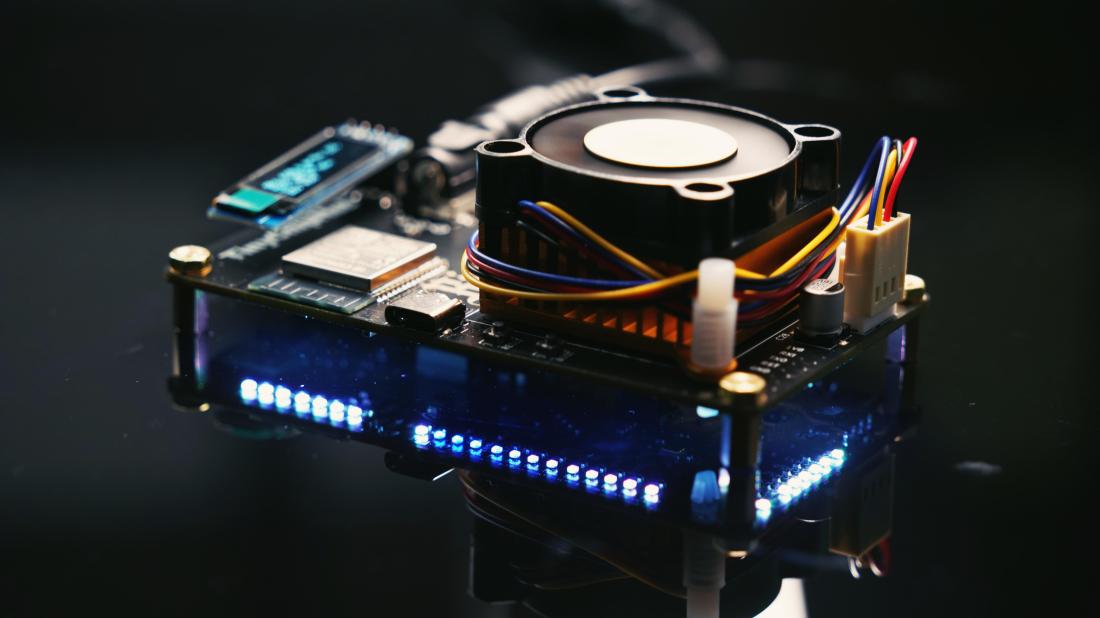
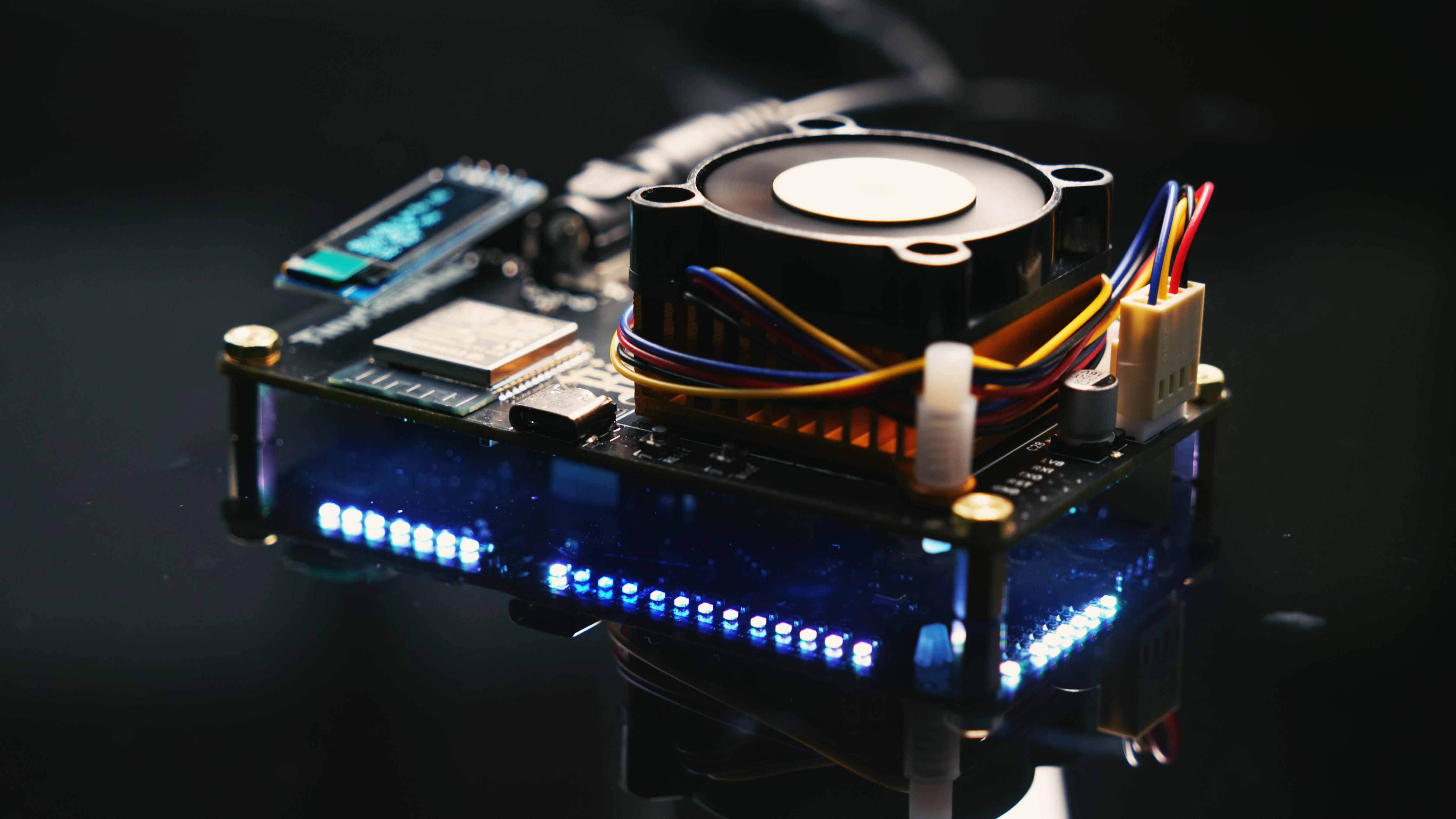
Technically, the Bitaxe Ultra uses one BM1366 chip, with a nominal hash rate of about 0.6 TH/s at default voltage. But some experts in the community might overclock a single chip to nearly 1 TH/s by modifying the firmware (of course, cooling must be enhanced, requiring additional fans). The typical operating power consumption is set around 14W, easily powered by a common 5V-6A power supply.
| Comparison Item | Bitaxe Ultra | Home Gaming PC Mining | Traditional ASIC Miner |
|---|---|---|---|
| Core Function | Independent Node + Mining | Hash Computation Only | Hash Computation Only |
| Noise Level | ~38 dB (like a fan) | Variable (depends on GPU) | >75 dB |
| Network Participation | 100% (Full Node) | 0% (Relies on Pool) | 0% (Relies on Pool) |
| Learning Curve | Steep | Moderate (GUI) | Flat (Plug and Play) |
In terms of compliance, this device follows the newbie-friendly path; it operates legally under the FCC (Federal Communications Commission) equipment certification framework, as long as you don't interfere with your neighbor's TV signals. But remember, its design purpose is hash rate education and network participation. ❄️ So, if you want a quiet "Bitcoin network terminal" that can sit on your living room bookshelf, occasionally offering a heart-racing lottery chance, the Bitaxe Ultra is currently the top choice for beginners.